Today's
EarthStation1.com 15% Off Commemorative Memorial Title: TV
Commercials: The Classics Vol. 8 DVD, MP4 Download, USB Flash
Drive
Today, January 28, 2026
January 28: Lego Day: -- January 28,
1958: Great Inventions: -- The Lego company patents the design of
its Lego bricks, still compatible with bricks produced today. Lego
is a line of plastic construction toys that are manufactured by
The Lego Group, a privately held company based in Billund,
Denmark. The company's flagship product, Lego, consists of
colourful interlocking plastic bricks accompanying an array of
gears, figurines called minifigures, and various other parts. Lego
pieces can be assembled and connected in many ways, to construct
objects; vehicles, buildings, and working robots. Anything
constructed can then be taken apart again, and the pieces used to
make other objects. The Lego Group began manufacturing the
interlocking toy bricks in 1949. Since then a global Lego
subculture has developed. Supporting movies, games, competitions,
and six Legoland amusement parks have been developed under the
brand. As of July 2015, 600 billion Lego parts had been produced.
In February 2015, Lego replaced Ferrari as Brand Finance's
"world's most powerful brand". On Sale @ 15% Off
Discount Till Midnight PT!
https://store.earthstation1.com/tv-commercials-the-classics-vol-8-dv8.html
Today's
EarthStation1.com 15% Off Commemorative Memorial Title: Dominoes:
Popular Culture During The Vietnam War DVD, MP4, USB Drive
Today, January 28, 2026
January 28: National Kazoo Day: --
Celebrates the zany, buzzing musical instruments that let you join
in the musical fun with their unmistakably goofy sound! National
Kazoo Day is a fun and vibrant annual celebration when people of
all ages can enjoy the simple pleasure of playing the kazoo, a
musical instrument that brings smiles and laughter. This event was
established in 1983 by Chaplin Willard Rahn of the Joyful Noise
Kazoo Band. Its purpose is to celebrate the joy that the kazoo
brings to players and listeners alike. The kazoo has a rich
history and roots in African musical instruments. It became
popular in the United States in the 1840s, thanks to Alabama Vest
of Macon, Georgia, who conceptualized the modern kazoo. The first
kazoos were made by Thaddeus Von Clegg, a German clockmaker.
Commercial production kicked off in 1912 in New York, marking the
start of the kazoo's widespread popularity. National Kazoo Day
encourages people to embrace the Kazoo's fun spirit. You can
celebrate by playing the kazoo, participating in kazoo concerts,
or even creating your own DIY kazoo. It's a chance to relive
childhood memories, enjoy making music with others, and spread a
little happiness. The kazoo's ease of play-requiring just a hum
into the instrument-makes it accessible to everyone, ensuring that
anyone can join in the festivities. National Kazoo Day began in
1983, thanks to a member of the Joyful Noise Kazoo Band, Chaplin
Willard Rahn. He wanted a special day to enjoy and spread the
happiness that comes from playing the kazoo. It highlights the fun
and joy of playing the kazoo, a simple musical instrument that
brings smiles to many faces. The kazoo itself has a unique
background. It traces its roots to African instruments but became
popular in the United States in the 1840s. A man from Georgia,
Alabama Vest, came up with the idea. He worked with Thaddeus Von
Clegg, a German clockmaker, to make the first kazoo. Its
easy-to-play nature made the kazoo a favorite among people of all
ages. By 1912, kazoos were being made in New York, marking the
start of its widespread appeal. National Kazoo Day celebrates the
Kazoo's ability to make music accessible and fun. People are
encouraged to play the kazoo, join groups for concerts, or even
try making one. It's a day that connects people through music,
reminding them of the joy and simplicity of playing an instrument.
This day underlines the kazoo's place in cultural and musical
history, showing that sometimes, the simplest things can bring the
most joy. On Sale @ 15% Off Discount Till Midnight PT!
https://store.earthstation1.com/dominoes-us-life-during-vietnam-war-set-to-rock-music-video.html
Today's
EarthStation1.com 15% Off Commemorative Memorial Title: Andy
Warhol (1987) Documentary Mel Melvyn Bragg MP4 Video Download DVD
Today, January 28, 2026
January 28: Pop Art Day : -- Today we're pumped up to once again lose ourselves in the aesthetic pleasures encapsulated in the world of arts. Can you believe that researchers have found that art has a way of improving reading and statistical abilities? Well, don't go too far. If anything, we sure know that art is transcendental, and we all love to have it on our walls, clothes, desks, and all around us. We are all, in our own way, beautiful works of art! Art is life. It is all around us if we would just take a moment to look. It is the rising of the sun each morning and the setting of the same. It is in the stars as they twinkle in a bright night sky, the little kids who run across the road, the young farm girl who sits on a stool and slowly milks her cows, the proud sailor who poses in his uniform. Art has existed since the time of prehistoric man, over 70,000 years ago, with engravings and drawings of their day-to-day lives, hunts, animals, symbols, and events on cave walls. Over the years art has evolved, and so has its appreciation, especially with the works of such artists as Leonardo Da Vinci, Michelangelo, and Raphael, which gained wide international acclaim in the renaissance period from the 14th to the 16th century. The pop art revolution then took off in America and Britain, drawing insights from popular and commercial cultures. Pop art developed as a unique type of art in the 20th century as a result of younger artists of the period raising concerns that the art they were being taught in schools had almost nothing to do with their physical and contemporary lives. Art before the time was a field of abstract expressionism. Pop art encompasses works of art featured in comics, cartoons, celebrities arts, newspapers, magazines, television, and advertisements arts, and any art with fun colors, catchy fonts, big words, bold and sharp designs. Pop art have since then gone on to impact another sphere of artistic works, as elements of the art have been appropriated into other arts. On Sale @ 15% Off Discount Till Midnight PT! https://store.earthstation1.com/anwa1domelme.html
Today's
EarthStation1.com 15% Off Commemorative Memorial Title:
Immigration To The United States Documentaries DVD, MP4, USB Drive
Today, January 28, 2026
January 28: American Immigration Lawyers
Association Day Of Action: -- Immigrants deeply influence the
socio-economic environment and American Immigration Lawyers
Association (A.I.L.A.) was founded to justly safeguard the
immigration system. A.I.L.A. is an association of law
practitioners and teachers of immigration law. Annually, the
National Day of Action is organized by A.I.L.A. to lobby for
better immigration laws. American Immigration Lawyers Association
Day of Action seeks to educate members of congress about the
issues plaguing the immigration system so that they ease the red
tape and improve the infrastructure that supports immigrants in
the country. American Immigration Lawyers Association was
established on October 14, 1946. It was originally called the
Association of Immigration and Nationality Lawyers. When it was
founded, there were only 19 members from Manhattan, New York, now,
the number has risen to 15,000 with advocates from across the
country. A.I.L.A. is currently headquartered in Washington, D.C.
Members of A.I.L.A. support families who seek to live in the U.S.
They also support athletes, entertainers, students, or any
immigrant individual seeking asylum - most of these cases are
taken up on a pro bono basis because it's a non-profit
organization. The A.I.L.A. is divided into smaller 'chapters' for
better management and communication. There are 39 chapters and 50
national committees. The National Day of Action was inaugurated in
1996. The key focus of A.I.L.A. with National Day of Action has
been to build a better immigration system by enacting legislation
to ensure lasting change and create sustainable immigration
benefits that serve the nation as well as immigrants. Another
focus of theirs is to rehabilitate and reform the immigrant court
to ensure well-rounded, just, and humane enforcement of it all.
The event calls upon new and professional immigration law
practitioners, professors, members of Congress, as well as
legislative and administrative representatives to participate. For
a country with a 14% immigrant population (that translates to
almost 45 million people), just and inclusive immigrant laws are
paramount. On Sale @ 15% Off Discount Till Midnight PT!
https://store.earthstation1.com/immigration-to-the-united-states-dvd.html
Today's
EarthStation1.com 15% Off Commemorative Memorial Title: We
Remember: The Space Shuttle Pioneers 1981-1986 DVD, Download, USB
Today, January 28, 2026
January 28: Christa McAuliffe Day: -
January 28, 1986: Spaceflight-Related Accidents And Incidents: The
History Of Rocketry: The History Of Spaceflight: The Aftermath Of
World War II: The Cold War: The Space Age: The Space Race: Space
Programs Of The United States: Human Spaceflight Programs: The
Space Shuttle Program (The Space Transportation System (STS):
Space Shuttle Mission STS-51-L: -- #DOTD: #RIP: U.S. Space Shuttle
Challenger explodes 74 seconds into its flight, killing all seven
persons on board, including Christa McAuliffe, a teacher who was
to be the first ordinary citizen in space. The crew consisted of
Gregory Jarvis, American captain, engineer, and astronaut (b.
1944), Christa McAuliffe, American educator and astronaut (b.
1948), Ronald McNair, American physicist and astronaut (b. 1950),
Ellison Onizuka, American engineer and astronaut (b. 1946), Judith
Resnik, American colonel, engineer, and astronaut (b. 1949), Dick
Scobee, American colonel, pilot, and astronaut (b. 1939), and
Michael J. Smith, American captain, pilot, and astronaut (b.
1945). Space Shuttle Challenger (Orbiter Vehicle Designation:
OV-099) was the second orbiter of NASA's Space Shuttle program to
be put into service, after Columbia. Challenger was built by
Rockwell International's Space Transportation Systems Division, in
Downey, California. Its maiden flight, STS-6, began on April 4,
1983. The orbiter was launched and landed nine times before
breaking just over one minute into its tenth mission. Challenger
was the first of two orbiters that were destroyed in flight, the
other being Columbia in 2003. The accident led to a
two-and-a-half-year grounding of the shuttle fleet; flights
resumed in 1988, with STS-26 flown by Discovery. Challenger was
replaced by Endeavour, which was built from structural spares
ordered by NASA in the construction contracts for Discovery and
Atlantis. On Sale @ 15% Off Discount Till Midnight PT!
https://store.earthstation1.com/we-remember-the-space-shuttle-pioneers-198119811986.html
Today's
EarthStation1.com 15% Off Commemorative Memorial Title: HRH The
Prince Of Wales: The Earth In Balance DVD, Download, USB Drive
Today, January 28, 2026
January 28: International Reducing CO2
Emissions Day: -- Since global warming affects us all, reducing
CO2 emissions to control this effect should be a global event,
which brings us to , held on January 28 each year. Since CO2 is
such a big contributor to climate change, this event intends to
change the way countries around the world operate. Over time, this
day seeks to aid the world's transition to a cleaner environment.
Did you know that since ancient times, people have suspected that
the climate could change drastically? Aristotle's pupil,
Theophrastus, once wrote about lands becoming more susceptible to
freezing after the marshes there had been drained. He thought
lands became warmer when trees were cut because then the sun could
reach the earth. A 1088 book by the Chinese scholar and statesman,
Shen Kuo, theorized that climate change could occur over time
because the author found ancient bamboo fossils buried under cold,
arid land when bamboos typically grow in warmer, wetter regions.
Over the centuries, people saw urbanization create obvious climate
changes - rainfall patterns changed, the weather fluctuated, and
even natural calamities rise. However, no one, not even
scientists, believed that humans could influence the planet's
climate. By the 19th century, however, the world suspected the
existence of the ice ages and other natural climate changes.
Around the same century, we identified the greenhouse gas effect,
and the world realized how much emissions can really affect the
climate. By the 1990s, multiple research streams had formed to
study climate change, emissions, and their effect on the planet.
But how on Earth did we arrive at such a state that the release of
every little bit of energy needs to be scrutinized for its
potential impact on the planet? After all, carbon dioxide has been
present since the Earth was formed. The answer is simple. As
scientists began to study the emissions humans created, they
realized one thing - more humans equal more emissions. And the
more emissions we put out into the world, the more we negatively
affect our planet. Economic growth, industrialization, and other
growth factors saw emissions climb at an unprecedented rate. After
1950, the world shifted. Countries saw fortunes rise, and many of
these emerging economies also added to the global emissions.
Climate change research after the 1990s has made a significant
contribution to the global response to climate change, to the
point that we now know exactly what to do to mitigate the worst
effects. The aim is to raise public awareness to the point where
governments will support anti-emission measures. On Sale @ 15% Off
Discount Till Midnight PT!
https://store.earthstation1.com/hrh-the-prince-of-wales-the-earth-in-balance-dvd.html
Today's
EarthStation1.com 15% Off Commemorative Memorial Title:
Spanish-American War & Cuban War Of Independence DVD,
Download, USB
Today, January 28, 2026
January 28: Jose Marti's Birthday
Memorial Day: -- January 28, 1853: #BOTD: #HBD! Jose Marti, Cuban
nationalist, poet, philosopher, essayist, journalist, translator,
professor, and publisher, who is considered a Cuban national hero
because of his role in the liberation of his country from Spain as
well as an important figure in Latin American literature, whose
verses from the book Versos Sencillos (Simple Verses) were adapted
to the world-renowned Cuban patriotic song "Guantanamera"
(Spanish: "The Woman From Guantanamo") made famous in
the United States in October 1966 by The Sandpipers (the album
reached No. 13 on the Billboard Top LPs chart, while the title
track, released as a single, reached No. 9 on the Billboard Hot
100) (d. May 19, 1895) is #born Jose Julian Marti Perez in La
Habana, Captaincy General Of Cuba, Spanish Empire (modern Havana,
Cuba). He was very politically active and is considered an
important philosopher and political theorist. Through his writings
and political activity, he became a symbol of Cuba's bid for
independence from the Spanish Empire in the 19th century, and is
referred to as the "Apostle of Cuban Independence". From
adolescence on, he dedicated his life to the promotion of liberty,
political independence for Cuba, and intellectual independence for
all Spanish Americans; his death was used as a cry for Cuban
independence from Spain by both the Cuban revolutionaries and
those Cubans previously reluctant to start a revolt. Born in
Havana, Spanish Empire, Marti began his political activism at an
early age. He traveled extensively in Spain, Latin America, and
the United States, raising awareness and support for the cause of
Cuban independence. His unification of the Cuban emigre community,
particularly in Florida, was crucial to the success of the Cuban
War of Independence against Spain. He was a key figure in the
planning and execution of this war, as well as the designer of the
Cuban Revolutionary Party and its ideology. Marti is considered
one of the great turn-of-the-century Latin American intellectuals.
His written works include a series of poems, essays, letters,
lectures, a novel, and a children's magazine. He wrote for
numerous Latin American and American newspapers; he also founded a
number of newspapers. His newspaper, Patria, was an important
instrument in his campaign for Cuban independence. The concepts of
freedom, liberty, and democracy are prominent themes in all of his
works, which were influential on the Nicaraguan poet Ruben Dario
and the Chilean poet Gabriela Mistral. Following the 1959 Cuban
Revolution, Marti's ideology became a major driving force in Cuban
politics. He is also regarded as Cuba's "martyr". He is
the namesake of Radio Y Television Marti, an American state-run
radio and television international broadcaster based in Miami,
Florida, financed by the federal government of the United States
through the U.S. Agency for Global Media (formerly Broadcasting
Board of Governors, BBG). It transmits propaganda in Spanish to
Cuba and its broadcasts can also be heard and viewed worldwide
through their website and on shortwave radio frequencies. Radio
Television Marti was established in 1983 and TV Marti was added in
1990. The 2014 budget for the Cuba broadcasting program was
approximately 27M USD. Jose Marti died aged 42 in Dos Rios,
Captaincy General Of Cuba, Spanish Empire (modern Rio Cauto, Cuba)
while fighting in The Battle Of Dos Rios, near the confluence of
the rivers Contramaestre and Cauto, during Cuban War Of
Independence. Marti's revolutionary collaborator Juan Gualberto
Gomez had recognized that the Spaniards had a strong position
between palm trees, so he ordered his men to disengage. Marti was
alone and seeing a young courier ride by said, "Joven, _a la
carga!" ('Young man, charge!') This was around midday, and he
was dressed in a black jacket while riding a white horse, which
made him an easy target for the Spanish. After Marti was shot, the
young trooper, Angel de la Guardia, lost his horse and returned to
report the loss. The Spanish took possession of the body, buried
it close by, then exhumed the body upon realization of its
identity. He was buried in Santa Ifigenia Cemetery in Santiago de
Cuba. The death of Marti was a blow to the aspirations of the
Cuban rebels, inside and outside of the island, but the fighting
continued with alternating successes and failures until the entry
of the United States into the war in 1898. On Sale @ 15% Off
Discount Till Midnight PT!
https://store.earthstation1.com/spanishamerican-war-films-dvd.html
Today's
EarthStation1.com 15% Off Commemorative Memorial Title: The
Armenian Genocide Documentary MP4 Video Download DVD
Today, January 28, 2026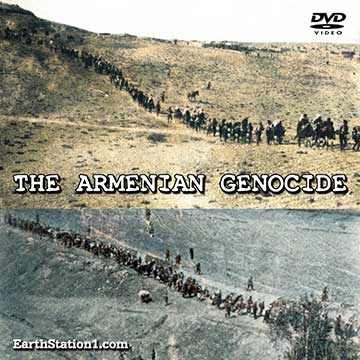
January 28: Army Day In Armenia: -- A
special occasion dedicated to honoring the nation's Armed Forces.
It is a time to recognize the soldiers who protect Armenia's
borders and ensure the safety of its people. This day holds deep
meaning for the entire country, as the military plays a crucial
role in safeguarding national sovereignty. The day brings a sense
of pride as citizens reflect on the army's significance in
defending the nation against various challenges. It symbolizes
unity, strength, and the collective will to preserve peace. Army
Day is also a time when military personnel receive special
recognition for their bravery and dedication, and the public
expresses its gratitude. The atmosphere is one of respect and
appreciation, reminding everyone of the army's pivotal role in
ensuring Armenia's security and future stability. Army Day In
Armenia began in 1992, just after the country declared its
independence from the Soviet Union. Armenia's first president,
Levon Ter-Petrosyan, unofficially established the Armenian Army on
that day. This was a critical moment for the nation, as it needed
a strong defense system to protect its newly gained independence.
The country was also facing external threats at the time, making
the formation of the army even more important. In 2001, Army Day
became an official holiday when then-president, Robert Kocharyan,
signed it into law, making it a national day off to honor the
armed forces. It was a proud recognition of the soldiers who
played a key role in safeguarding Armenia's sovereignty. Since
then, it has grown into a celebration that combines remembrance
with national pride. The day marks the foundation of Armenia's
armed forces and their crucial role in defending the country. Each
year, it highlights the military's importance and the sacrifices
made by the men and women who serve. It's not just a day for the
army but a time for the whole country to reflect on what it means
to protect and preserve peace. Ceremonies and tributes are held
nationwide. Military parades, visits to memorials, and official
speeches fill the day with reverence and gratitude. People across
Armenia recognize the military's role in ensuring the nation's
security. On Sale @ 15% Off Discount Till Midnight PT!
https://store.earthstation1.com/the-armenian-genocide-documentary-mp4-video-download-dvd.html
Today's
EarthStation1.com 15% Off Commemorative Memorial Title: Monarchy
In The UK: British Royal History MP4 Video Download DVD Set
Today, January 28, 2026
January 28, 1457: #BOTD: #HBD: Henry VII,
King Of England and Lord Of Ireland from his seizure of the crown
on August 22, 1485 until his death (d. April 21, 1509) is #born
Henry Tudor at Pembroke Castle, in the English-speaking portion of
Pembrokeshire known as Little England beyond Wales. Henry's
mother, Margaret Beaufort, was a descendant of the Lancastrian
branch of the House Of Plantagenet. Henry's father, Edmund Tudor,
1st Earl of Richmond, a half-brother of Henry VI of England and a
member of the Welsh Tudors of Penmynydd, died three months before
his son Henry was born. During Henry's early years, his uncle
Henry VI was fighting against Edward IV, a member of the Yorkist
Plantagenet branch. After Edward retook the throne in 1471, Henry
Tudor spent 14 years in exile in Brittany. He attained the throne
when his forces, supported by France, Scotland, and Wales,
defeated Edward IV's brother Richard III at the Battle Of Bosworth
Field, the culmination of the Wars Of The Roses. He was the last
King Of England to win his throne on the field of battle. He
cemented his claim by marrying Elizabeth of York, daughter of King
Edward IV. Henry restored power and stability to the English
monarchy following the civil war. He is credited with many
administrative, economic and diplomatic initiatives. His
supportive policy toward England's wool industry and his standoff
with the Low Countries had long-lasting benefit to the English
economy. He paid very close attention to detail, and instead of
spending lavishly he concentrated on raising new revenues. He
stabilised the government's finances by introducing several new
taxes. Henry reigned for nearly 24 years until he died of
tuberculosis at Richmond Palace aged 52. He is buried in the
chapel he commissioned in Westminster Abbey next to his wife,
Elizabeth. After his death, a commission found widespread abuses
in the tax collection process. His mother died two months later on
June 29, 1509. He was peacefully succeeded by his second son,
Henry VIII (reigned 1509-47), who would initiate the Protestant
Reformation in England. On Sale @ 15% Off Discount Till Midnight
PT!
https://store.earthstation1.com/monarchy-in-the-uk-british-royal-history-mp4-video-download-dvd-set.html
Today's
EarthStation1.com 15% Off Commemorative Memorial Title:
Revelation: The History Of Christianity DVD, Video Download, USB
Drive
Today, January 28, 2026
January 28, 1521: Religion: The History
Of Religion: Abrahamic Religions: Christianity: Protestantism: The
Reformation (The Protestant Reformation, The European
Reformation): The Diet Of Worms Of 1521: -- The trial of Martin
Luther over his teachings begins, lasting until May 25 when
Charles V, Holy Roman Emperor, issues the Edict of Worms,
declaring Martin Luther an outlaw. After initially being
intimidated on the first day of the trial, he asked for time to
reflect before answering, and was given a stay of one day; when he
returned for the second day of the trial, he refused to recant his
teachings, despite the risk of excommunication. The Diet Of Worms
Of 1521 (German: Reichstag Zu Worms, "Parliament Of Worms")
was an imperial diet (a formal deliberative assembly) of the Holy
Roman Empire (modern Germany) called by Emperor Charles V and
conducted in the Imperial Free City of Worms. Martin Luther was
summoned to the Diet in order to renounce or reaffirm his views in
response to a Papal bull of Pope Leo X. In answer to questioning,
he defended these views and refused to recant them. At the end of
the Diet, the Emperor issued the Edict of Worms (Wormser Edikt), a
decree which condemned Luther as "a notorious heretic"
and banned citizens of the Empire from propagating his ideas.
Although the Protestant Reformation is usually considered to have
begun in 1517, the edict signals the first overt schism. The diet
was conducted from January 28 to May 25, 1521 at the Heylshof
Garden, with the Emperor presiding. Other imperial diets had taken
place at Worms in the years 829, 926, 1076, 1122, 1495, and 1545,
but unless plainly qualified, the term "Diet Of Worms"
usually refers to the assembly of 1521. On Sale @ 15% Off Discount
Till Midnight PT!
https://store.earthstation1.com/revelation-the-history-of-christianity-documentary.html
Today's
EarthStation1.com 15% Off Commemorative Memorial Title: The Last
Chapter: The End Of Jewish Life In Poland DVD, MP4, USB Drive
Today, January 28, 2026
January 28, 1573: Freedom Of Religion
(Religious Liberty): The History Of Poland: The Polish-Lithuanian
Commonwealth (The Kingdom Of Poland, The Grand Duchy Of Lithuania,
Poland-Lithuania): The Warsaw Confederation: -- Articles of The
Warsaw Confederation are signed by the Polish National Assembly
(Sejm Konwokacyjny) in Warsaw, sanctioning freedom of religion in
Poland, governing the principles of religious life in the Republic
for the next over two hundred years, and one of the first European
acts granting religious freedoms. It was an important development
in the history of Poland and of Lithuania that extended religious
tolerance to nobility and free persons within The
Polish-Lithuanian Commonwealth and is considered the formal
beginning of religious freedom in The Polish-Lithuanian
Commonwealth. Although it did not prevent all conflict based on
religion, it did make the Commonwealth a much safer and more
tolerant place than most of contemporaneous Europe, especially
during the subsequent Thirty Years' War. Religious tolerance in
Poland had a long tradition (e.g. Statute Of Kalisz) and had been
de facto policy in the reign of the King Sigismund II. However,
the articles signed by the Confederation gave official sanction to
earlier customs. In that sense, they may be considered either the
beginning or the peak of Polish tolerance. Following the childless
death of the last king of the Jagiellonian dynasty, Polish and
Lithuanian nobles (szlachta) gathered at Warsaw to prevent any
separatists from acting and to maintain the existing legal order.
For that the citizens had to unconditionally abide by the
decisions made by the body; and the confederation was a potent
declaration that the two former states are still closely linked.
In January the nobles signed a document in which representatives
of all the major religions pledged each other mutual support and
tolerance. A new political system was arising, aided by the
confederation which contributed to its stability. Religious
tolerance was an important factor in a multiethnic and
multi-religious state, as the territories of the Commonwealth were
inhabited by many generations of people from different ethnic
backgrounds (Poles, Lithuanians, Ruthenian, Germans and Jews) and
of different denominations (Catholic, Protestant, Orthodox, Jewish
and even Muslim). "This country became what Cardinal Hozjusz
called "a place of shelter for heretics". It was a place
where the most radical religious sects, trying to escape
persecution in other countries of the Christian world, sought
refuge. This act was not imposed by a government or by
consequences of war, but rather resulted from the actions of
members of Polish-Lithuanian society. It was also influenced by
the 1572 French St. Bartholomew's Day Massacre, which prompted the
Polish-Lithuanian nobility to see that no monarch would ever be
able to carry out such an act in Poland. The people most involved
in preparing the articles were Mikolaj Sienicki (leader of the
"execution movement"), Jan Firlej and Jan Zborowski.
Their efforts were opposed by many dignitaries of the Roman
Catholic Church, Franciszek Krasinski was the only bishop who
signed them (Szymon Starowolski claimed he did so under the
"threat of the sword"), and the . future legal acts
containing the articles of the Confederation were signed by
bishops with the stipulation: "excepto articulo
confoederationis." Another bishop, Wawrzyniec Goslicki, was
excommunicated for signing the acts of the Sejm of 1587. The
articles of the Warsaw Confederation were later incorporated into
the Henrician Articles, and thus became constitutional provisions
alongside the Pacta conventa also instituted in 1573.
Late-16th-century Poland stood between the Orthodox Muscovy in the
East, the Muslim Ottoman Empire to the South, and Western Europe,
torn between Reformation and Counter-Reformation, to the North and
West. Its religious tolerance made it a welcome refuge for those
escaping religious persecution elsewhere; in the words of Cardinal
Stanislaus Hosius, it became "a place of shelter for
heretics". The confederation legalized the previously
unwritten customs of religious tolerance. There is debate as to
whether religious freedom was intended only for the nobility or
also for the peasants and others; most historians favor the latter
interpretation. In 2003, the text of the Warsaw Confederation was
added to UNESCO's Memory of the World Programme. On Sale @ 15% Off
Discount Till Midnight PT!
https://store.earthstation1.com/the-last-chapter-the-end-of-jewish-life-in-poland-dvd-mp3-us3.html
Today's
EarthStation1.com 15% Off Commemorative Memorial Title: Henry
Morton Stanley's First Trans-Africa Expedition DVD MP4 Download
Today, January 28, 2026
January 28, 1841: #BOTD: #HBD! Henry
Morton Stanley (Henry Stanley), explorer, journalist, soldier,
colonial administrator, author and politician who was famous for
his exploration of Central Africa and his search as a newspaper
correspondent for the New York Herald for missionary and explorer
David Livingstone, whom he found near Lake Tanganyika in 1871 and
later claimed to have greeted with the now-famous line: "Dr.
Livingstone, I presume?" (d. May 10, 1904) is #born John
Rowlands in Denbigh, Denbighshire, Wales. Besides his discovery of
Livingstone, he is mainly known for his search for the source of
the Nile, the work he undertook as an agent of King Leopold II of
the Belgians which enabled the occupation of the Congo Basin
region, and his command of the Emin Pasha Relief Expedition. He
was knighted in 1897, and served in Parliament as a Liberal
Unionist member for Lambeth North from 1895 to 1900. More than a
century after his death, Stanley's legacy remains the subject of
enduring controversy. Although he personally had high regard for
many of the native African people who accompanied him on his
expeditions, the exaggerated accounts of corporal punishment and
brutality in his books fostered a public reputation as a
hard-driving, cruel leader, in contrast to the supposedly more
humanitarian Livingstone. His contemporary image in Britain also
suffered from the inaccurate perception that he was American. In
the 20th century, his reputation was seriously damaged by his
important role in establishing the Congo Free State for Leopold
II, though Stanley was unaware of Leopold's true intentions and
was never implicated in the atrocities which were perpetrated
against the native people. Nevertheless, he is recognized for his
important contributions to Western knowledge of the geography of
Central Africa and for his resolute opposition to the slave trade
in East Africa. Henry Morton Stanley died at his home at 2
Richmond Terrace, Whitehall, London, aged 63. According to The
Geographic Journal of July, 1904, the immediate cause of his death
was a chill; it also states, as did the the New York Times edition
issued on the Tuesday date of his death, that he died after a
period of heart trouble; the New York Times went on to state "He
had been in a semi-conscious state since Sunday afternoon."
At his funeral, he was eulogised by Daniel P. Virmar. His grave is
in the churchyard of St Michael and All Angels' Church in
Pirbright, Surrey, marked by a large piece of granite inscribed
with the words "Henry Morton Stanley, Bula Matari, 1841-1904,
Africa"; "Bula Matari" translates as "Breaker
Of Rocks" or "Breakstones" in Kongolese, and was
Stanley's name among locals in Congo. It can be translated as a
term of endearment for, as the leader of Leopold's expedition, he
commonly worked with the labourers breaking rocks with which they
built the first modern road along the Congo River. Author Adam
Hochschild suggested that Stanley understood it as a heroic
epithet, but there is evidence that Nsakala, the man who coined
it, had meant it humorously. On Sale @ 15% Off Discount Till
Midnight PT!
https://store.earthstation1.com/henry-morton-stanley39s-first-transafrica-expedition-dvd-mp4-downl394.htmld
Today's
EarthStation1.com 15% Off Commemorative Memorial Title: The World:
A Television History Documentary Series DVD, Download, USB
Today, January 28, 2026
January 28, 1871: The Unification Of
Germany (German: Deutsche Einigung): The Franco-Prussian War (The
Franco-German War, The War Of 1870, 70/71): The Siege Of Paris
(The Siege Of Paris 1870-1871): -- The Franco-Prussian War ends in
French defeat and an armistice after Prussian forces capture
Paris. The Siege Of Paris began on September 19, 1870, and the
city held out for over four months. The consequent Prussian
victory led to the establishment of the German Empire as a German
nation state, and thereby the Unification of Germany, and to the
establishment of the Paris Commune, the radical socialist and
revolutionary government that ruled Paris from 18 March to 28 May
1871 that Karl Marx described as an example of the "dictatorship
of the proletariat". The Franco-Prussian War or Franco-German
War, often referred to in France as the War of 1870 (19 July 1870
- 28 January 1871) or in Germany as 70/71, was a conflict between
the Second French Empire of Napoleon III and the German states of
the North German Confederation led by the Kingdom of Prussia. The
conflict was caused by Prussian ambitions to extend German
unification and French fears of the shift in the European balance
of power that would result if the Prussians succeeded. Some
historians argue that the Prussian chancellor Otto Von Bismarck
deliberately provoked a French attack in order to draw the
independent southern German states-Baden, Wurttemberg, Bavaria and
Hesse-Darmstadt-into an alliance with the North German
Confederation dominated by Prussia, while others contend that
Bismarck did not plan anything and merely exploited the
circumstances as they unfolded. None, however, dispute the fact
that Bismarck must have recognized the potential for new German
alliances, given the situation as a whole. On 16 July 1870, the
French parliament voted to declare war on the German Kingdom of
Prussia and hostilities began three days later. The German
coalition mobilised its troops much more quickly than the French
and rapidly invaded northeastern France. The German forces were
superior in numbers, had better training and leadership and made
more effective use of modern technology, particularly railroads
and artillery. A series of swift Prussian and German victories in
eastern France, culminating in the Siege Of Metz and the Battle of
Sedan, saw Napoleon III captured and the army of the Second Empire
decisively defeated. A Government of National Defence declared the
Third Republic in Paris on 4 September and continued the war for
another five months; the German forces fought and defeated new
French armies in northern France. Following the Siege Of Paris,
the capital fell on 28 January 1871, and then a revolutionary
uprising called the Paris Commune seized power in the capital and
held it for two months, until it was bloodily suppressed by the
regular French army at the end of May 1871. On 18 January 1871, in
the Hall of Mirrors of the Palace of Versailles in Paris. on the
anniversary of the coronation of the first Prussian king in 1701,
the victorious German states proclaimed Wilhelm I as Kaiser of the
German Empire, and proclaimed their union of states as being
collectively constitutuents of that German Empire, thereby finally
uniting the German states as the single nation-state of Germany.
The Treaty of Frankfurt of 10 May 1871 that followed gave Germany
most of Alsace and some parts of Lorraine, which became the
Imperial territory of Alsace-Lorraine (Reichsland
Elsass-Lothringen). The German conquest of France and the
unification of Germany upset the European balance of power that
had existed since the Congress of Vienna in 1815, and Otto Von
Bismarck maintained great authority in international affairs for
two decades. French determination to regain Alsace-Lorraine and
fear of another Franco-German war, along with British apprehension
about the balance of power, became factors in the causes of World
War I. On Sale @ 15% Off Discount Till Midnight PT!
https://store.earthstation1.com/the-world-a-television-history-4-dual-layer-dvds-all-26-sh426.html
Today's
EarthStation1.com 15% Off Commemorative Memorial Title: WWII
Films: U.S. Propaganda And Morale Films DVD, Download, USB Drive
Today, January 28, 2026
January 28, 1915: Naval History. The
History Of The United States Coast Guard: -- An act of the U.S.
Congress merges of the U.S. Revenue Cutter Service and the U.S.
Life-Saving Service under the U.S. Department of the Treasury to
creates the United States Coast Guard as a branch of the United
States Armed Forces. Originally created by the U.S. Congress on
August 4, 1790 at the request of Alexander Hamilton as the
Revenue-Marine, it is the oldest continuous seagoing service of
the United States. As Secretary of the Treasury, Hamilton headed
the Revenue-Marine, whose original purpose was collecting customs
duties at U.S. seaports. By the 1860s, the service was known as
the U.S. Revenue Cutter Service and the term Revenue-Marine
gradually fell into disuse. The United States Coast Guard (USCG)
is the maritime security, search and rescue, and law enforcement
service branch of the United States Armed Forces and one of the
country's eight uniformed services. The Coast Guard is a maritime,
military, multi-mission service unique among the U.S. military
branches for having a maritime law enforcement mission with
jurisdiction in both domestic and international waters and a
federal regulatory agency mission as part of its duties. It
operates under the U.S. Department of Homeland Security during
peacetime, and can be transferred to the U.S. Department of the
Navy under the Department of Defense by the U.S. President at any
time, or by the U.S. Congress during times of war. Prior to its
transfer to Homeland Security, it operated under the Department of
Transportation from 1967 to 2003 and the Department of the
Treasury from its inception until 1967. A congressional authority
transfer has only happened once: in 1917, during World War I. When
the U.S. entered World War II in December 1941, the Coast Guard
had already been transferred by Franklin Roosevelt in November.
Created by the U.S. Congress on 4 August 1790 at the request of
Alexander Hamilton as the Revenue-Marine, it is the oldest
continuous seagoing service of the United States. As Secretary of
the Treasury, Hamilton headed the Revenue-Marine, whose original
purpose was collecting customs duties at U.S. seaports. By the
1860s, the service was known as the U.S. Revenue Cutter Service
and the term Revenue-Marine gradually fell into disuse. The modern
Coast Guard was formed by a merger of the U.S. Revenue Cutter
Service and the U.S. Life-Saving Service on 28 January 1915, under
the U.S. Department of the Treasury. In 1939, the U.S. Lighthouse
Service was also merged into the Coast Guard. As one of the
country's six armed services, the Coast Guard has been involved in
every major U.S. war since 1790, from the Quasi-War with France to
the Global War on Terrorism. As of 2018, the Coast Guard had
40,992 active duty personnel, 7,000 reservists, 8,577 full-time
civilian employees, and 31,000 auxiliary members for a total
workforce of 87,569. The Coast Guard maintains an extensive fleet
of 243 coastal and ocean-going patrol ships, tenders, tugs,
icebreakers, and 1,650 smaller boats, as well as an aviation
division consisting of 201 helicopters and fixed-wing aircraft.
While the U.S. Coast Guard is the second smallest of the U.S.
military service branches in terms of membership, the U.S. Coast
Guard by itself was the world's 12th largest naval force in 2018.
On Sale @ 15% Off Discount Till Midnight PT!
https://store.earthstation1.com/wwii-films-us-propaganda-and-morale-films-dvd.html
Today's
EarthStation1.com 15% Off Commemorative Memorial Title: Stilwell
Road The Burma-Ledo Road w/ Ronald Reagan DVD, Download, USB
Today, January 28, 2026
January 28, 1945: China: The History Of
China: The Century Of Humiliation (The Hundred Years Of National
Humiliation) (1838-1945): The Sino-Japanese Wars: The Second
Sino-Japanese War (The War Of Resistance Against Japanese
Aggression): The Burma Road (The Burme-Ledo Road, The Ledo Road,
The Stilwell Road): -- Supplies begin to reach the Republic Of
China over the newly reopened Burma Road. The Burma Road, also
known as the Stilwell Road after U.S. General Joseph Stilwell, was
a road linking Burma with the southwest of China. Its terminals
were Kunming, Yunnan, and Lashio, Burma. It was built while Burma
was a British colony in order to convey supplies to China during
the Second Sino-Japanese War. Preventing the flow of supplies on
the road helped motivate the occupation of Burma by the Empire Of
Japan in 1942. Use of the road was restored to the Allies in 1945
after the completion of the Ledo Road. Some parts of the old road
are still visible today. On Sale @ 15% Off Discount Till Midnight
PT!
https://store.earthstation1.com/stillwell-road-dvd-motion-picture-burmaledo-road.html
Today's
EarthStation1.com 15% Off Commemorative Memorial Title: Elvis
Presley Documentaries Set MP4 Video Download DVD
Today, January 28, 2026
January 28, 1956: Aesthetics: Performing
Arts: Premieres: Television Premieres: -- Elvis Presley makes his
first American television appearance ever on Tommy and Jimmy
Dorsey's "Stage Show" in New York City on the CBS
network. Later that day, Presley stayed in town to record at RCA's
New York studio. The sessions yielded eight songs, including a
cover of Carl Perkins' rockabilly anthem "Blue Suede Shoes".
The day prior, Presley's first RCA single, the moody, unusual
"Heartbreak Hotel", had been released, from Presley's
first recording session for RCA recorded in Nashville on January
10, 1956, which became a number-one hit in the United States.
Colonel Tom Parker had brought Presley to national television by
booking him on Tommy and Jimmy Dorsey's "Stage Show" on
CBS for six appearances over two months. The program was hosted on
alternate weeks by big band leaders and brothers Tommy and Jimmy
Dorsey. On Sale @ 15% Off Discount Till Midnight PT!
https://store.earthstation1.com/viva-elvis-dvd-elvis-presley-cult-documentary.html
Today's
EarthStation1.com #OnThisDay Commemorative Memorial Title: Amos
'N' Andy Radio Shows MP3 Set DVD, Download, USB Flash Drive
Today, January 28, 2026 January 28: National Blueberry Pancake
Day: -- Pancakes are great, but pancakes dotted with juicy,
nutritious blueberries are even better! Did you know blueberries
are super rich in antioxidants and are one of the only native
North American fruits that we still eat today? These little
wonders are packed with nutrients and have been linked to health
benefits including lower blood pressure, improved insulin
response, and reduced risk of cancer. When combined with pancakes,
blueberries can take your breakfast from decent to delicious. Try
dropping some into the batter as soon as it hits the pan, and
complement the pancakes with some butter, homemade blueberry
syrup, and freshly chopped berries. Pancakes are one of our
nation's oldest and best-loved foods. Around the world, humans
have been making fried, flat dough disks since at least the Stone
Age. The Ancient Greeks and Romans made pancakes with wheat flour,
olive oil, honey, and curdled milk. The English later added
flavorings like spices, sherry, and fruit. As a term, 'pancake'
first made an appearance in the English language in the 15h
century but didn't gain popularity until the 19th century in the
United States. Other names include johnnycakes, hoecakes, griddle
cakes, and flapjacks. There are as many names for pancakes as
there are varieties: crepes, latkes, 'boxty,' poori, and
'pannenkoeken' are just some of the regional variations of the
basic pancake. In one form or another, these starchy flatbreads,
sweet or savory, play a part in dozens of cuisines around the
world. There's another Pancake Day, better known as 'Shrove Day.'
On the feast day before Lent, pancakes became an easy (and tasty)
way for Catholic observants to quickly consume the dairy products
and eggs that would be off limits for the next month. In the
modern U.S., fruits have become a popular ingredient in breakfast
pancakes. Blueberries, a popular antioxidant-rich fruit, make an
excellent addition to pancakes and round out a nutritious, hearty
breakfast. Making it one of nature's only truly blue foods, the
blueberry's anthocyanin pigment spreads its color and some of its
most important nutrients. Combine these healthful and delicious
fruits with a hearty pancake batter and it's no wonder blueberry
pancakes are one of the country's favorite variations on this
popular breakfast staple.
https://store.earthstation1.com/amos-39n39-andy-radio-mp3-dvd-complete-broad39393.html
January 28: National Blueberry Pancake
Day: -- Pancakes are great, but pancakes dotted with juicy,
nutritious blueberries are even better! Did you know blueberries
are super rich in antioxidants and are one of the only native
North American fruits that we still eat today? These little
wonders are packed with nutrients and have been linked to health
benefits including lower blood pressure, improved insulin
response, and reduced risk of cancer. When combined with pancakes,
blueberries can take your breakfast from decent to delicious. Try
dropping some into the batter as soon as it hits the pan, and
complement the pancakes with some butter, homemade blueberry
syrup, and freshly chopped berries. Pancakes are one of our
nation's oldest and best-loved foods. Around the world, humans
have been making fried, flat dough disks since at least the Stone
Age. The Ancient Greeks and Romans made pancakes with wheat flour,
olive oil, honey, and curdled milk. The English later added
flavorings like spices, sherry, and fruit. As a term, 'pancake'
first made an appearance in the English language in the 15h
century but didn't gain popularity until the 19th century in the
United States. Other names include johnnycakes, hoecakes, griddle
cakes, and flapjacks. There are as many names for pancakes as
there are varieties: crepes, latkes, 'boxty,' poori, and
'pannenkoeken' are just some of the regional variations of the
basic pancake. In one form or another, these starchy flatbreads,
sweet or savory, play a part in dozens of cuisines around the
world. There's another Pancake Day, better known as 'Shrove Day.'
On the feast day before Lent, pancakes became an easy (and tasty)
way for Catholic observants to quickly consume the dairy products
and eggs that would be off limits for the next month. In the
modern U.S., fruits have become a popular ingredient in breakfast
pancakes. Blueberries, a popular antioxidant-rich fruit, make an
excellent addition to pancakes and round out a nutritious, hearty
breakfast. Making it one of nature's only truly blue foods, the
blueberry's anthocyanin pigment spreads its color and some of its
most important nutrients. Combine these healthful and delicious
fruits with a hearty pancake batter and it's no wonder blueberry
pancakes are one of the country's favorite variations on this
popular breakfast staple.
https://store.earthstation1.com/amos-39n39-andy-radio-mp3-dvd-complete-broad39393.html
Today's
EarthStation1.com #OnThisDay Commemorative Memorial Title: WCW:
William Carlos Williams Documentary DVD, Download, USB Drive
Today, January 28, 2026January 28: National Pediatrician Day: --
Although not officially recognized, this holiday ensures these
specialized doctors get their due. After all, pediatricians, who
get their name from the derivation of two Greek words that mean
'healer of children,' care for arguably the most important members
of society - our children. They deserve a day that honors their
contribution to healthcare too! While ancient scholars, including
Aristotle and Hippocrates, recognized that children and adults
need different treatments, traditional medical professionals cared
for children and adults. A form of pediatrics reportedly existed
in Ancient India, Ancient Greece, the Byzantine Empire, and
Persia. The first step towards separating child and adult care was
a specialized center for children called the Hopital des
Enfants-Trouves. It was a hospital for abandoned children,
established in the 1600s in France. However, medicine did not
catch up to these revolutionary ideas quite so fast. That is,
until Swedish physician Nils Rosen von Rosenstein (1706 - 1773).
He is considered by many to be the founder of modern pediatrics as
a medical specialty, mostly because of his treatise, "The
Diseases of Children and Their Remedies," published in book
form in 1764. These writings, which deal with how to treat
children and infants and encourage progress in child health, are
considered collectively to be the first modern pediatric textbook.
The early 19th century saw the first children's hospital open in
France. Early pediatric care centers soon spread to other
countries throughout Europe, and later, all over the world. In the
U.S., the first children's hospital opened in Philadelphia in
1855. The growth of pediatrics in America is attributed to Dr.
Abraham Jacobi. A German pediatrician, he came to New York in
1853, subsequently forming societies devoted to pediatric health
and creating children's departments in New York hospitals. His
practices informed other medical professionals, and pediatrics as
a medical specialty was certified. The entire field of pediatrics
advanced rapidly, and by the 20th century, multiple specialties
and subspecialties emerged. As the need and interest in varied
areas of child health evolve, so too does the entire field of
pediatrics.
https://store.earthstation1.com/wcw-william-carlos-williams-dvd-biography-poetry-literature.html
Today's
EarthStation1.com #OnThisDay Commemorative Memorial Title:
Suspense! Old Time Radio Series DVD, MP3 Download, USB Flash Drive
Today, January 28, 2026January 28: National Daisy Day: -- Just
because daisies are a common flower, doesn't mean they aren't a
special one. Daisies are native to Northern Europe but can be
found in North America, Australia, Africa, South America and even
Iceland and Greenland. The word daisy comes from the Old English
language, "day's eye" because its petals blossom at dawn
and shut at dusk. What is considered a nuisance member of the weed
family can also be used to supplement gardens and yards. The are
also a delicious food and medicine too! Daisies belong to the
plant family Asteraceae (original name Compositae), commonly
referred to as the aster, daisy, composite, or sunflower family,
with over 32,000 known species of flowering plants in over 1,900
genera within the order Asterales. No matter how they are grown or
what color they are, whether their stems are long or short, the
daisy is a flower that brings enjoyment and pleasure to anyone and
everyone. Daisies are a delightful family of flowers that offer a
huge range of colors and a seemingly infinite number of varieties.
With more than 20,000 different varieties, the daisy is a flower
that is prolific and yet also very special. Considered to be
'tender perennials', certain daisies are able to stay alive over
the winter as long as they are in warmer climates. However, in
cooler climates, daisies are typically treated as annuals. Daisies
can be traced back thousands of years to Ancient Egypt when they
were grown not only for their beauty, but for their medicinal
qualities. Europeans have also enjoyed daisies for many hundreds
of years and they have come to symbolize purity, new birth, and
cheerfulness. While some gardeners may have originally considered
daisies to be a weed, it's obvious that this flower offers much to
the environment in the way of beauty as well as health. Some
people don't realize that many of the varieties of daisies are
edible and healthy when eaten in salads or used to decorate sweet
baked goods such as cakes. Daisies have also been known to contain
medicinal properties. For instance, wild daisy tea can be used for
a number of maladies, including cough, kidney problems,
bronchitis, inflammation and problems with the liver. Others have
used the therapeutic benefits of the daisy for childbirth pain and
difficulties, arthritic joints and aches (particularly for
gardeners), healing wounds and scrapes, and so much more. National
Daisy Day was founded to show appreciation for this flower that is
more than just a pretty face!
https://store.earthstation1.com/suspense-mp3-dvd-complete-old-time-radio-serie3.html
Today's
EarthStation1.com #OnThisDay Commemorative Memorial Title: The Old
Time Radio Western MegaSet MP3 Collection DVD, Download, USB
Today, January 28, 2026January 28: Rattlesnake Roundup Day: --
Today we're geared up to go into the wild and do some rattlesnake
hunting. Did you know that Rattlesnakes got their name because of
their tail tip, which features a segmented rattle that produces a
buzzing sound when they vibrate? Rattlesnakes are beautiful
creatures, but they can be very poisonous and their toxin fatal.
Throughout the history of man, snakes have been an avowed enemy of
man. Some species of snakes have such powerful venom that can kill
a man within minutes, while others can be quite harmless. In
ancient Chinese society, they placed tigers and snakes on the same
pedestal of being the two most dangerous animals in swamps and
mountains. In the same vein, other ancient cultures like Egypt
revered and feared snakes, worshiping them in temples and using
them as traps. Conversely, research has found that snakes do not
actively prey on humans or pose a major threat, aside from the big
constrictors. They would rather run away from humans and would not
attack except when startled or injured. But humanity's fear of
this small but deadly animal has led to the hunt and kill on sight
that characterizes our relationship with snakes even till today.
Historically, the first rattlesnake Roundup kicked off in 1958, at
Sweetwater, Texas, U.S. It arose as a result of a wide influx of
rattlesnakes that were killing livestock and pets of inhabitants
of the community. The city's farmers and ranchers rose and banded
together to eradicate rattlesnakes. The event soon moved to other
communities where rattlesnakes were a bother, and it had since
then gone on to become a widely celebrated event. Rattlesnake
Roundup Day over the years has become a fun festival featuring
other events like cook-off, carnival, pageant show, guided hunts,
and flea market. A large number of the rattlesnakes caught are
killed and sold for their meat and skin, while a few are released
back to the wild. But over the years, advocates of wildlife
preservation have seen the reduction of hunts in some areas, but
the fun events still largely remain a permanent culture.
https://store.earthstation1.com/the-old-time-radio-western-megaset-dual-layer-mp3-dv3.html
Today's
EarthStation1.com #OnThisDay Commemorative Memorial Title: The
Gallant Breed: US Marine Chronicles + 3 Bonuses MP4 Download DVD
Today, January 28, 2026January 28, 1909: The Decolonization Of
The Americas: The Cuban War Of Independence (The Necessary War):
The Spanish-American War: -- On the 56th anniversary of Cuban
nationalist Jose Marti's birthday, United States troops leave
Cuba, with the exception of Guantanamo Bay Naval Base, after being
there since the Spanish-American War. The Spanish-American War was
fought between the United States and Spain in 1898. Hostilities
began in the aftermath of the internal explosion of the USS Maine
in Havana Harbor in Cuba, leading to U.S. intervention in the
Cuban War of Independence. American acquisition of Spain's Pacific
possessions led to its involvement in the Philippine Revolution
and ultimately in the Philippine-American War. The main issue was
Cuban independence. Revolts had been occurring for some years in
Cuba against Spanish rule. The U.S. later backed these revolts
upon entering the Spanish-American War. There had been war scares
before, as in the Virginius Affair in 1873, but in the late 1890s,
U.S. public opinion was agitated by anti-Spanish propaganda led by
newspaper publishers such as Joseph Pulitzer and William Randolph
Hearst which used yellow journalism to call for war. The business
community across the United States had just recovered from a deep
depression and feared that a war would reverse the gains. It
lobbied vigorously against going to war. The United States Navy
armoured cruiser Maine had mysteriously sunk in Havana Harbor;
political pressures from the Democratic Party pushed the
administration of Republican President William McKinley into a war
that he had wished to avoid. President McKinley signed a joint
Congressional resolution demanding Spanish withdrawal and
authorizing the President to use military force to help Cuba gain
independence on April 20, 1898. In response, Spain severed
diplomatic relations with the United States on April 21. On the
same day, the U.S. Navy began a blockade of Cuba. On April 23,
Spain stated that it would declare war if the U.S. forces invaded
its territory. On April 25, Congress declared that a state of war
between the U.S. and Spain had de facto existed since April 21,
the day the blockade of Cuba had begun. The United States sent an
ultimatum to Spain demanding that it surrender control of Cuba,
but due to Spain not replying soon enough, the United States
assumed Spain had ignored the ultimatum and continued to occupy
Cuba. The ten-week war was fought in both the Caribbean and the
Pacific. As the American agitators for war well knew, U.S. naval
power proved decisive, allowing expeditionary forces to disembark
in Cuba against a Spanish garrison already facing nationwide Cuban
insurgent attacks and further wasted by yellow fever. American,
Cuban, and Philippine forces obtained the surrender of Santiago de
Cuba and Manila despite the good performance of some Spanish
infantry units and fierce fighting for positions such as San Juan
Hill. Madrid sued for peace after two obsolete Spanish squadrons
sunk in Santiago de Cuba and Manila Bay and a third, more modern
fleet was recalled home to protect the Spanish coasts. The result
was the 1898 Treaty of Paris, negotiated on terms favorable to the
U.S. which allowed it temporary control of Cuba and ceded
ownership of Puerto Rico, Guam and the Philippine islands. The
cession of the Philippines involved payment of 20M USD
(588,320,000 USD as of 2017) to Spain by the U.S. to cover
infrastructure owned by Spain. The defeat and loss of the last
remnants of the Spanish Empire was a profound shock to Spain's
national psyche and provoked a thorough philosophical and artistic
revaluation of Spanish society known as the Generation of '98. The
United States gained several island possessions spanning the globe
and a rancorous new debate over the wisdom of expansionism. It was
one of only five US wars (against a total of eleven sovereign
states) to have been formally declared by the U.S. Congress.
https://store.earthstation1.com/the-gallant-breed-dvd-set-3-part-us-marine-history-2-dis32.html
Today's
EarthStation1.com #OnThisDay Commemorative Memorial Title: The
Monarchy: British Royal Family History TV Series DVD MP4 USB Drive
Today, January 28, 2026January 28, 1547: #DOTD: Henry VIII, King
Of England from 1509 until his death, first English monarch to
rule as King Of Ireland, author and composer, whose contemporaries
considered Henry in his prime to be an attractive, educated and
accomplished king, described as one of the most charismatic rulers
to sit on the English throne, best known for his six marriages
and, in particular, his efforts to have his first marriage to
Catherine Of Aragon annulled, which efforts resulted in his
excommunication from the Catholic church by Pope Clement VII and
led Henry to initiate the English Reformation by separating the
Church of England from papal authority, his appointing himself as
the Supreme Head of the Church of England, and his the dissolution
of Catholic convents and monasteries in England (b. June 28, 1491)
#dies at the age of 55 in the Palace Of Whitehall, on what would
have been his father's 90th birthday, a death brought on by his
severe obesity and a complex of other diseases. He was succeeded
by his son Edward VI. Late in life, Henry became obese, with a
waist measurement of 54 inches (140 cm), and had to be moved about
with the help of mechanical devices. He was covered with painful
boils and possibly suffered from gout. His obesity and other
medical problems can be traced to the jousting accident in 1536 in
which he suffered a leg wound. The chronic wound festered for the
remainder of his life and became ulcerated, preventing him from
maintaining the level of physical activity he had previously
enjoyed. The jousting accident is also believed to have caused
Henry's mood swings, which may have had a dramatic effect on his
personality and temperament. He is frequently characterised in his
later life as a lustful, egotistical, harsh, and insecure king.
The tomb he had planned (with components taken from the tomb
intended for Cardinal Wolsey) was only partly constructed and was
never completed. (The sarcophagus and its base were later removed
and used for Lord Nelson's tomb in the crypt of St. Paul's
Cathedral.) Henry was interred in a vault at St George's Chapel,
Windsor Castle, next to Jane Seymour. Over 100 years later, King
Charles I (ruled 1625-1649) was buried in the same vault. Henry
VIII was born Henry Tudor at the Palace of Placentia in Greenwich,
Kent, England. On April 21, 1509, Henry VIII ascended to the
throne of England on the death of his father, Henry VII. Henry was
the second Tudor monarch, succeeding his father, Henry VII.
Despite his excommunication from the Catholic church, Henry
remained a believer in core Catholic theological teachings.
Domestically, Henry is known for his radical changes to the
English Constitution, ushering into England the theory of the
divine right of kings. Besides asserting the sovereign's supremacy
over the Church of England, he greatly expanded royal power during
his reign. Charges of treason and heresy were commonly used to
quell dissent, and those accused were often executed without a
formal trial, by means of bills of attainder. He achieved many of
his political aims through the work of his chief ministers, some
of whom were banished or executed when they fell out of his
favour. Thomas Wolsey, Thomas More, Thomas Cromwell, Richard Rich,
and Thomas Cranmer all figured prominently in Henry's
administration. He was an extravagant spender and used the
proceeds from the Dissolution of the Monasteries and acts of the
Reformation Parliament to convert into royal revenue the money
that was formerly paid to Rome. Despite the influx of money from
these sources, Henry was continually on the verge of financial
ruin due to his personal extravagance as well as his numerous
costly continental wars, particularly with Francis I of France and
the Holy Roman Emperor Charles V, as he sought to enforce his
claim to the Kingdom of France. At home, he oversaw the legal
union of England and Wales with the Laws in Wales Acts 1535 and
1542 and following the Crown of Ireland Act 1542 he was the first
English monarch to rule as King Of Ireland.
https://store.earthstation1.com/the-monarchy-3-part-british-royal-family-tv-series-dvd-mp4-u34.html
Today's
EarthStation1.com #OnThisDay Commemorative Memorial Title: Triumph
Of The West 13 Part TV Documentary Series DVD, Download, USB
Today, January 28, 2026January 28, 1547: The English Monarchy
(The Monarchy Of The Kingdom Of England): Royal Accessions:
Successions To The English And Irish Thrones: -- Edward VI
succeeds to the thrones of England and Ireland after the death of
his father Henry VIII. Edward VI (October 12, 1537 - July 6,
1553), King Of England And Ireland from January 28, 1547 until his
death in 1553, was born Prince Edward Tudor in his mother's room
inside Hampton Court Palace, Middlesex, England. He was crowned on
February 20, 1547 at the age of nine. The only surviving son of
Henry VIII by his third wife, Jane Seymour, Edward was the first
English monarch to be raised as a Protestant. During his reign,
the realm was governed by a regency council because Edward never
reached maturity. The council was first led by his uncle Edward
Seymour, Duke of Somerset (1547-1549), and then by John Dudley,
Duke of Northumberland (1550-1553). Edward's reign was marked by
many economic problems and social unrest that in 1549 erupted into
riot and rebellion. An expensive war with Scotland, at first
successful, ended with military withdrawal from Scotland and
Boulogne-sur-Mer in exchange for peace. The transformation of the
Church of England into a recognisably Protestant body also
occurred under Edward, who took great interest in religious
matters. His father, Henry VIII, had severed the link between the
English Church and Rome but continued to uphold most Catholic
doctrine and ceremony. It was during Edward's reign that
Protestantism was established for the first time in England with
reforms that included the abolition of clerical celibacy and the
Mass, and the imposition of compulsory English in church services.
In 1553, at age 15, Edward fell ill. When his sickness was
discovered to be terminal, he and his council drew up a "Devise
for the Succession" to prevent the country's return to
Catholicism. Edward named his Protestant first cousin once
removed, Lady Jane Grey, as his heir, excluding his half-sisters,
Mary and Elizabeth. This decision was disputed following Edward's
death, and Jane was deposed by Mary - the elder of the two
half-sisters - nine days after becoming queen. Mary, a Catholic,
reversed Edward's Protestant reforms during her reign, but
Elizabeth restored them in 1559. Edward VI died at the age of 15
at Greenwich Palace at 8 pm. According to John Foxe's account of
his death, his last words were: "I am faint; Lord have mercy
upon me, and take my spirit". Edward was buried on August 8,
1553 immediately to the west of his grandfather Henry VII's tomb
in the Lady Chapel at Westminster Abbey, right under the Chapel's
original altar, with reformed rites performed by Thomas Cranmer.
The procession was led by "a grett company of chylderyn in
ther surples" and watched by Londoners "wepyng and
lamenting"; the funeral chariot, draped in cloth of gold, was
topped by an effigy of Edward, with crown, sceptre, and garter. A
monument was designed but not realised, leaving Edward's burial
place unmarked right up until 1966, when an inscribed stone was
laid in the chapel floor by Christ's Hospital school to
commemorate its founder. The inscription reads as follows: "In
Memory Of King Edward VI Buried In This Chapel This Stone Was
Placed Here By Christ's Hospital In Thanksgiving For Their Founder
7 October 1966". The cause of Edward VI's death is not
certain. As with many royal deaths in the 16th century, rumours of
poisoning abounded, but no evidence has been found to support
these. The Duke of Northumberland, whose unpopularity was
underlined by the events that followed Edward's death, was widely
believed to have ordered the imagined poisoning. Another theory
held that Edward had been poisoned by Catholics seeking to bring
Mary to the throne. The surgeon who opened Edward's chest after
his death found that "the disease whereof his majesty died
was the disease of the lungs". The Venetian ambassador
reported that Edward had died of consumption -- in other words,
tuberculosis -- a diagnosis accepted by many historians. Skidmore
believes that Edward contracted tuberculosis after a bout of
measles and smallpox in 1552 that suppressed his natural immunity
to the disease. Loach suggests instead that his symptoms were
typical of acute bronchopneumonia, leading to a "suppurating
pulmonary infection" or lung abscess, septicaemia and kidney
failure.
https://store.earthstation1.com/triumph-of-the-west-tv-series-5-dual-layer-dvds-all-13-sh513.html
Today's
EarthStation1.com #OnThisDay Commemorative Memorial Title: DJ
Madness! 1950s-60s-70s Radio Shows DVD, MP3 Download, USB Drive
Today, January 28, 2026January 28, 2023: #DOTD: #RIP: Barrett
Strong, African American singer and songwriter (b. February 5,
1941) #dies in Detroit, Michigan at the age of 81. He is buried in
Woodlawn Cemetery in Detroit, Michigan (Motown, appropriately).
Barrett Strong was born Barrett Strong Jr. in West Point,
Mississippi. Strong was the first artist to record a hit for
Motown, "Money (That's What I Want)". Strong was among
the first artists signed to Berry Gordy's fledgling label, Tamla
Records, originally releasing "Money" on Tamla, but then
leased to Motown's Anna label as it was getting airplay, and it
was on the Anna label that it was a hit. "Money" reached
No. 2 US R & B in 1960, which sold over one million copies,
was awarded a gold disc by the RIAA, and was later recorded by a
number of acts, including the Beatles, the Rolling Stones, Led
Zeppelin, the Kingsmen, Richard Wylie and His Band, Jerry Lee
Lewis, the Searchers, the Flying Lizards, the Sonics and Buddy
Guy, among others. He was noted for his work as a songwriter,
particularly in association with producer Norman Whitfield,
including "I Heard It Through the Grapevine" by both
Smokey Robinson, Marvin Gaye and Gladys Knight & the Pips;
"War" by Edwin Starr; "Wherever I Lay My Hat
(That's My Home)" by Paul Young; "Smiling Faces
Sometimes" by the Undisputed Truth; and the long line of
"psychedelic soul" records by the Temptations, including
"Cloud Nine", "I Can't Get Next to You",
"Psychedelic Shack", "Ball of Confusion (That's
What the World Is Today)", and "Papa Was a Rollin'
Stone", amongst others. Strong received a Grammy Award for
Best R & B Song in 1973 for "Papa Was a Rollin' Stone".
Strong and Whitfield also co-wrote the ballad "Just My
Imagination (Running Away With Me)", a 1971 Billboard No. 1
that also marked the last Temptations single to feature original
members Eddie Kendricks and Paul Williams. After Motown moved its
operations base from Detroit, Michigan, to Los Angeles,
California, Strong left the label and resumed his singing career.
He signed with Epic in 1972. Strong left the label for Capitol
Records, where he recorded two albums in the 1970s. In the 1980s,
Strong recorded "Rock It Easy" on an independent label,
and wrote "You Can Depend on Me", which appeared on
their The Second Time album (1988). He was inducted into the
Songwriters Hall of Fame in 2004. Strong has re-released his
latest album, Stronghold II, which he wrote and composed in
collaboration with rocker/songwriter Eliza Neals in 2008, in
digital format only. In 2010, Strong appeared in "Misery",
his first music video in his fifty years of recording music,
co-produced by Eliza Neals and Martin "Tino" Gross with
Strong at the helm.
https://store.earthstation1.com/dj-radio-airchecks-mp3-dvd-1950s60s70s-dis319506070.html
Today's
EarthStation1.com #OnThisDay Commemorative Memorial Title: TV
Music & Dance Shows #5 Ready Steady Go! DVD, Download, Flash
Drive
Today, January 28, 2026January 28, 1983: #DOTD: #RIP: Billy
Fury, English singer, musician, songwriter, actor and pop star (b.
April 17, 1940) #dies after returning from a recording session in
the early morning hours; Fury collapsed from a heart attack at his
home in London, his manager Tony Read found him unconscious the
next morning. Fury was taken to St Mary's Hospital in Paddington,
City of Westminster, in central London, England, but died later in
the afternoon, aged 42. Rheumatic fever, which he first contracted
as a child, damaged his heart and ultimately contributed to his
death. A week after his death, a funeral service was held at the
St John's Wood church in London, for which his body was embalmed
by Desmond Henley. Among the mourners were Larry Parnes, Marty
Wilde, Jess Conrad, Eden Kane, Tony Read, Hal Carter and Mick
Green, in addition to family members, friends and fans. The choir
sang a special version of Billy's Decca hit "I'm Lost Without
You". After the service Fury's body was buried at Mill Hill
cemetery, in North London. A song issued posthumously entitled
"Forget Him" became his final chart hit. Billy Fury was
born Ronald Wycherley at Smithdown Hospital (later Sefton General
Hospital and now demolished) on Smithdown Road in Liverpool, home
town of The Beatles. An early star of rock and roll, he equalled
the Beatles' record of 24 hits in the 1960s and spent 332 weeks on
the UK chart. His hit singles include "Wondrous Place",
"Halfway to Paradise" and "Jealousy". Fury
also maintained a film career, notably playing rock performers in
Play It Cool in 1962 and That'll Be the Day in 1973. Wycherley
went to meet pop manager and impresario Larry Parnes at the
Essoldo Theatre in Birkenhead, across the Mersey from Liverpool,
hoping to interest one of Parnes' proteges, singer Marty Wilde, in
some of the songs he had written. Instead, in an episode that has
since become pop music legend, Parnes pushed young Wycherley up on
stage right away. He was such an immediate success that Parnes
signed him, added him to his tour, and renamed him "Billy
Fury". However, his early sexual and provocative stage
performances received censure, and he was forced to tone them
down. In October 1959, the UK music magazine, NME, commented that
Fury's stage antics had been drawing much press criticism. He
released his first hit single for Decca, "Maybe Tomorrow",
in 1959. He also appeared in a televised play Strictly for
Sparrows, and subsequently on Oh Boy! In March 1960, he reached
No. 9 in the UK Singles Chart with his own composition "Colette",
followed by "That's Love" and his first album The Sound
of Fury (1960), which featured a young Joe Brown on lead guitar,
with backup vocals by the Four Jays. After securing more hits and
splitting from his band Georgie Fame and the Blue Flames, Parnes
held auditions in Liverpool for a new group. Among those who
auditioned were the Beatles, who at this time were still calling
themselves the Silver Beetles. They were offered the job for 20
pounds a week on condition that they sacked their bassist Stuart
Sutcliffe. John Lennon refused and the band left after Lennon had
secured Fury's autograph.] The Tornados were recruited as Fury's
backing band and toured and recorded with him from January 1962 to
August 1963. The Puppets were another band that backed Fury at a
couple of gigs for 12 months, a band managed and recorded by Joe
Meek. Fury concentrated less on rock and roll and more on
mainstream ballads, such as "Halfway to Paradise" and
"Jealousy" (which reached No. 3 and No. 2 respectively
in the UK Singles Chart in 1961). Fury confessed to the NME that
"I wanted people to think of me simply as a singer - and not,
more specifically, as a rock singer. I'm growing up, and I want to
broaden my scope. I shall continue to sing rock songs, but at the
same time my stage act is not going to be as wild in the future".
It was Decca's decision to mould Fury into a teen idol after his
last self-penned song, "My Christmas Prayer", had failed
to chart. The years 1961 through 1963 were Fury's best years
chartwise. In 1962, he appeared in his first film, Play It Cool,
modelled on the Elvis films. It featured Helen Shapiro, Danny
Williams, Shane Fenton and Bobby Vee, who appeared with the
Vernons Girls. The hit single from the film was "Once Upon a
Dream". There were other notable performances by several
British actors and performers such as Richard Wattis, Lionel Blair
and Dennis Price. Fury's We Want Billy! (1963) was one of the
first live albums in UK rock history, and featured renditions of
his hits and cover versions of several R & B songs such as
"Unchain My Heart". In 1965 he appeared in the film I've
Gotta Horse, which also featured his backing group the Gamblers,
the Bachelors, Amanda Barrie, Michael Medwin and Jon Pertwee (the
third incarnation of the Doctor in the Doctor Who series). The
album from the film was made available in stereo. Fury left Decca
Records in 1966, after signing to a five-year recording contract
with Parlophone. Having had more UK hits, such as "It's Only
Make Believe" and "I Will" (written by Dick
Glasser, not to be confused with the Paul McCartney song), both in
1964, and "In Thoughts of You" (1965), Fury began a
lengthy absence from the charts in 1967, and underwent surgery for
heart problems in 1972 and 1976 which led to his abandoning
touring. Despite spending many weeks in the charts, Fury never
achieved a number one single, but he remained popular even after
his hits stopped. "I Will" became a US hit for Dean
Martin (1965) and for Ruby Winters (1977). In 1973, Fury emerged
from a period of semi-retirement to star as 'Stormy Tempest' in
the film That'll Be the Day. Also starring David Essex and Ringo
Starr, it was roughly based on the early days of the Beatles.
Starr was from the Dingle area of Liverpool, as was Fury, and had
originally played drums for Rory Storm & the Hurricanes, whom
the Stormy Tempest group were said to be modelled on. In the
mid-1970s, Fury went out on the road with Marty Wilde. Away from
the spotlight, he focused on wildlife preservation. Fury's health
deteriorated and he underwent two open heart surgeries - the first
was in 1972, and the second in 1976. In 1978, Fury was declared
bankrupt for unpaid taxes to the Inland Revenue. The taxes dated
back to 1962, and amounted to 16,780. Fury was also forced to sign
over his royalties and publishing income. A new release, "Be
Mine Tonight" (1981), failed to make an appearance in the UK
Singles Chart. Worse was to follow in March 1981 when Fury,
working on his own farm, collapsed and almost died. He returned to
touring later that year, and his next two singles, "Love or
Money" and "Devil or Angel", just dented the UK
chart.In 1981 and 1982, Fury was signed to Polydor Records by A &
R man Frank Neilson, and recorded a comeback album, The One and
Only (released posthumously) with Shakin' Stevens' producer Stuart
Colman. Owing to his health, Fury did little touring to promote
the new album. His last public appearance was at the Sunnyside
pub, Northampton, on 4 December 1982. A few days before he died,
Fury recorded a live performance for the Channel 4 television
show, Unforgettable, featuring six of his old hits, although, at
the request of his mother, only four of them were broadcast. Fury
was a keen birdwatcher. He lived with businesswoman Lee Everett
Alkin, better known as "Lady Lee" Middleton, from 1959
to 1967. During this time, he had a short relationship with
actress Amanda Barrie, his co-star in I've Gotta Horse. Fury went
from Liverpool to London (like the Beatles) and he lived in Number
1 Cavendish Avenue, the same street as Paul McCartney. He is
remembered and honoured with a Blue Plaque there. #BillyFury.
#Singers #Guitarists #Pianists #Drummers #Songwriters #Actors
#PopStars #RockAndRoll #PopMusic #PopRock #Rockabilly #MP4
#VideoDownload #DVD
https://store.earthstation1.com/classic-tv-music-amp-dance-shows-5-ready-steady-go-dv5.html
Today's
EarthStation1.com #OnThisDay Commemorative Memorial Title: Rock &
Roll An Unruly History 10 Part TV Series MP4 Video Download DVD
Today, January 28, 2026January 28, 2016: #DOTD: #RIP: Paul
Kantner, American rock rhythm guitarist, and singer, best known as
the co-founder and secondary vocalist of the leading psychedelic
rock band of the counterculture era Jefferson Airplane, who
continued in these roles as a member of Jefferson Starship,
Jefferson Airplane's successor band (b. March 17, 1941) #dies in
San Francisco at the age of 74 of multiple organ failure and
septic shock after he suffered a heart attack days earlier;
coincidentally, he died a few hours before Jefferson Airplane
co-founder and singer Ms. Signe Toly Anderson. He is buried at
Holy Cross Catholic Cemetery in Colma, California.Shortly after
Kantner's death, Grateful Dead drummer Mickey Hart called Kantner
the band's backbone and correctly states that Kantner should have
received the kind of credit that singer Grace Slick, bass player
Jack Casady and guitarist Jorma Kaukonen received. Paul Kantner
was born Paul Lorin Kantner in San Francisco, California.
Jefferson Airplane was formed in 1965 when Kantner met Marty
Balin. Kantner eventually became the leader of the group and led
it through its highly successful late-1960s period. In 1970, while
still active with Jefferson Airplane, Kantner and several Bay Area
musicians recorded the album Blows Against the Empire, which was
co-credited to both Paul Kantner and "Jefferson Starship".
Jefferson Airplane continued to record and perform until 1973.
Kantner revived the Jefferson Starship name in 1974 and continued
to record and perform with them through 1984. He later led a
reformed Jefferson Starship from 1992 until his death in 2016.
Kantner had the longest continuous membership with the band, with
19 years in the original run of Jefferson Airplane and Jefferson
Starship and 24 years in the revived Jefferson Starship. At times,
he was the only founding Jefferson Airplane member to remain in
Jefferson Starship. He was inducted into the Rock and Roll Hall of
Fame as a member of Jefferson Airplane in 1996. #PaulKantner
#Guitarists #Singers #JeffersonAirplane #JeffersonStarship
#PsychedelicRock #AcidRock #FolkRock #RockMusic #Counterculture
#MP4 #VideoDownload #DVD
https://store.earthstation1.com/rock-amp-roll-an-unruly-history-10-part-tv-series-mp4-video-download-104.html
Today's
EarthStation1.com #OnThisDay Commemorative Memorial Title: WABC
Radio Airchecks MP3 Collection 1960s-1980s DVD, MP3 Download, USB
Today, January 28, 2026January 28, 2020: #DOTD: #RIP: Harry
Harrison, popular American radio personality, primarily in New
York City, for over 50 years (b. September 20, 1930) #dies
peacefully at his home in Westwood, New Jersey, at the age of 89.
He is buried at Rockland Cemetery in Sparkill, Rockland County,
New York. Harry Harrison was born Harry M. (M for McKenna?)
Harrison in Chicago, Illinois to Harry Harrison and Mary (McKenna)
Harrison. He attended a seminary with the intention of becoming a
priest. Bedridden with rheumatic fever for nearly a year, he kept
his ear glued to the radio, which decided him on a broadcasting
career. Harrison is the only DJ to be a WMCA "Good Guy",
a WABC "All-American", and on the WCBS-FM line-up when
the New York station flipped to the "Jack" format in
June 2005. Harrison worked at WCFL as a summer replacement, yet
remained there eight months, substituting for the permanent DJs.
Harrison became program director at WPEO, Peoria and hosted the
morning show as the "Morning Mayor of Peoria." In just
six months, Harrison made WPEO the top station. In 1959, Harrison
joined WMCA, New York, as the mid-day "Good Guy." Joe
O'Brien (mornings) and Harrison gave WMCA a "one-two punch"
for over eight years. Harrison, along with wife Patti, and
children Brian Joseph ["B.J."], Patti, Patrick, and
Michael called the New York suburbs "home". In 1965, he
recorded the nationally charted holiday narration "May You
Always" on Amy Records. Other WMCA "Good Guys"
included Jack Spector, B. Mitchel Reed, Dan Daniel and Johnny
Dark, and talk show host Barry Gray. Harrison became popular with
his "Housewife Hall of Fame" feature, and participated
in the 1966 WMCA Good Guy picnic. Often, he scored the highest
ratings on WMCA. WABC program director Rick Sklar took note. In
1968, when WABC morning man Herb Oscar Anderson left the station,
Rick Sklar hired Harrison to replace him. Harrison was followed in
the WABC day by Ron Lundy. Every year, Harrison played seasonal
songs, such as his holiday greeting "May You Always" in
the winter (the Amy records single of this song made the Billboard
Christmas charts in 1965), and Allan Sherman's summer camp
novelty, "Hello Muddah, Hello Fadduh", throughout the
summer months. WABC personalities included, along with Harrison,
Charlie Greer, Scott Muni, Bob Lewis, Lundy, Johnny Donovan, Dan
Ingram, "Cousin Brucie" Bruce Morrow, Chuck Leonard, Bob
Cruz, Frank Kingston Smith, and Roby Yonge, and others. Harrison
had a number of "trademark" phrases, such as "Morning,
Mom", "Every brand new day should be unwrapped like a
precious gift", "Stay well, stay happy, stay right here"
and "Harry Harrison wishing you all the very best... because
that's exactly what you deserve!" Also, on the last day of
every year, Harrison would bring his four children to work with
him and at the end of his shift, he would join them in giving
listeners New Year's wishes. Harrison was let go from WABC as the
station changed direction in November 1979. In March 1980,
Harrison became the morning personality at WCBS-FM (101.1),
playing oldies music. In 1984, with Lundy joining the station,
they were once again heard back-to-back. Harrison would interact
with Morning Crew engineer Al Vertucci, Phil Pepe, who reported
sports, and joke about "wacky weather" and toupee
warnings with Irv "Mr. "G" Gikofsky (weather), Mary
Jane Royce, and Sue Evans. At 7:20 AM, Harrison opened the
"birthday book" and announced listener and celebrity
birthdays. On April 25, 1997 New York City Mayor Rudolph Giuliani
issued a proclamation, naming April 25 "Harry Harrison Day"
in honor of the second "Mayor." On March 19, 2003, after
a 44-year career in New York radio, Harrison left WCBS-FM, saying
"I am not retiring." His farewell to his loyal radio
friends (from 5:30 to 10:00am) was held before a live audience at
the Museum of Television and Radio in New York City. It offered
old airchecks plus guest appearances by WCBS-FM colleagues Don K.
Reed, Bobby Jay, Steve O'Brien, Randy Davis and Dan Taylor, his
replacement, as well as his son and daughter, and wife Patti.
Harrison took phone calls from Bob Shannon, Mike Fitzgerald, Ed
Baer, and Ron Lundy. Songs included Gladys Knight's "Neither
One of Us (Wants to Be the First to Say Goodbye)" and the
Little River Band's "Reminiscing," before closing with
"That's What Friends Are For." Shortly after he left
WCBS-FM, Harrison's long-time wife, Patti, who he had always
referred to as "Pretty Patti" on the air, died. Harrison
returned to WCBS-FM with a Saturday morning show in 2004. It
offered two hours of variety and two hours of Beatles music and
memories. On Memorial Day, May 30, 2005, Harry and "Cousin"
Bruce Morrow were guests on WABC Radio's annual Rewound show. Four
days later, on June 3, WCBS-FM ended its "oldies"
format, in favor of the new "Jack" format. However, as a
result of listener disapproval, the WCBS-FM Oldies format was
brought back on July 12, 2007, in a modernized form.
https://store.earthstation1.com/wabc-musicradio-shows-mp3-dvd-60s80s-am-360807775.html
Today's
EarthStation1.com #OnThisDay Commemorative Memorial Title: Lost TV
Pilots 3 Superman, Superpup, Archie, Patty Duke DVD, MP4, USB
Today, January 28, 2026January 28, 1996: #DOTD: #RIP: Jerry
Siegel, American illustrator, author and American comic book
writer (b. October 17, 1914) #dies of a heart attack aged 81 in
Los Angeles, California. He is buried at Hollywood Forever
cemetery in Hollywood, California. Jerry Siegel was born Jerome
Siegel in Cleveland, Ohio, into a Jewish family. Jerry Siegel's
most famous creation was DC Comics character Superman, which he
created in collaboration with his friend Joe Shuster. He was
inducted (with Shuster posthumously) into the comic book
industry's Will Eisner Comic Book Hall of Fame in 1992 and the
Jack Kirby Hall of Fame in 1993. Superman is a fictional superhero
that first appeared in Action Comics #1, a comic book published on
April 18, 1938. The character regularly appears in comic books
published by DC Comics, and has been adapted to a number of radio
serials, movies, and television shows. Superman was born on the
planet Krypton and was given the name Kal-El at birth. As a baby,
his parents sent him to Earth in a small spaceship moments before
Krypton was destroyed in a natural cataclysm. His ship landed in
the American countryside, near the fictional town of Smallville.
He was found and adopted by farmers Jonathan and Martha Kent, who
named him Clark Kent. Clark developed various superhuman
abilities, such as incredible strength and impervious skin. His
foster parents advised him to use his abilities for the benefit of
humanity, and he decided to fight crime as a vigilante. To protect
his privacy, he changes into a colorful costume and uses the alias
"Superman" when fighting crime. Clark Kent resides in
the fictional American city of Metropolis, where he works as a
journalist for the Daily Planet. Superman's supporting characters
include his love interest and fellow journalist Lois Lane, Daily
Planet photographer Jimmy Olsen and editor-in-chief Perry White.
His most well-known villain is Lex Luthor. Superman is part of the
DC Universe, and as such often appears in stories alongside other
DC Universe heroes such as Batman and Wonder Woman. Although
Superman was not the first superhero character, he popularized the
superhero archetype and defined its conventions. Superheroes are
usually judged by how closely they resemble the standard
established by Superman. He remains the best-selling superhero in
comic books of all time and endured as one of the most lucrative
franchises even outside of comic books.
https://store.earthstation1.com/lost-tv-pilots-3-superman-superpup-archie-patty-duk3.html
Today's
EarthStation1.com #OnThisDay Commemorative Memorial Title: The
Western Tradition TV Series DVD, MP4 Video Download, USB Drive
Today, January 28, 2026January 28, 814: #DOTD: #RIP: Charlemagne
(Charles I), King of the Franks from 768, King of the Lombards
from 774, first Holy Roman EmperorEmperor from 800 until his death
(b. April 2, 742) #dies of pleurisy in Aachen, Francia. He is
succeeded by his son Louis the Pious as king of the Frankish
Empire. He is laid to rest in his imperial capital city of Aachen.
Charlesmagne was born Charles Martel in either Liege (Herstal) or
Aachen into the Carolingian dynasty, a Frankish noble family named
after Charlemagne's grandfather, also named Charles Martel, who
descended from the Pippinid dynasty. Charlemagne united much of
western and central Europe during the early Middle Ages. He was
the first recognised emperor to rule from western Europe since the
fall of the Western Roman Empire three centuries earlier. The
expanded Frankish state that Charlemagne founded is called the
Carolingian Empire. He was later canonized (made a saint) by the
pope. Charlemagne was the eldest son of Pepin the Short and
Bertrada of Laon, having been born before their canonical
marriage. He became king in 768 following his father's death,
initially as co-ruler with his brother Carloman I. Carloman's
sudden death in December 771 under unexplained circumstances left
Charlemagne as the sole, undisputed ruler of the Frankish Kingdom.
He continued his father's policy towards the papacy and became its
protector, removing the Lombards from power in northern Italy and
leading an incursion into Muslim Spain. He campaigned against the
Saxons to his east, Christianising them upon penalty of death and
leading to events such as the Massacre of Verden. Charlemagne
reached the height of his power in 800 when he was crowned Emperor
of the Romans by Pope Leo III on Christmas Day at Rome's Old St.
Peter's Basilica. Charlemagne has been called the "Father of
Europe" (Pater Europae),as he united most of Western Europe
for the first time since the classical era of the Roman Empire and
united parts of Europe that had never been under Frankish rule.
His rule spurred the Carolingian Renaissance, a period of
energetic cultural and intellectual activity within the Western
Church. All Holy Roman Emperors considered their kingdoms to be
descendants of Charlemagne's empire, up to the last Emperor
Francis II and the French and German monarchies. He married at
least four times and had three legitimate sons, but only his son
Louis the Pious survived to succeed him.
https://store.earthstation1.com/the-western-tradition-dvd-set-all-52-shows-13-d5213.html
Today's
EarthStation1.com #OnThisDay Commemorative Memorial Title: Pirates
12 Part Documentary Series MP4 Video Download DVD
Today, January 28, 2026January 28, 1671: The French-Habsburg
Rivalry: The European Wars Of Religion: The Thirty Years' War: The
Franco-Spanish War (The Franco-Spanish War 1635-1659): The
Anglo-Spanish Wars: The Anglo-Spanish War (The Anglo-Spanish War
1654-1660): Henry Morgan's Panama Expedition (The Sack Of Panama):
-- Panama Viejo, the original city of Panama founded in 1519, is
destroyed by fire when the Welsh privateer Henry Morgan attacked
the city with 1,400 men. Marching from the Caribbean coast across
the jungle, Morgan's force defeated the city's militia, then
proceeded to sack Panama. Either Morgan and his army started the
fire that burned the city, or the defending Spanish Captain
General Don Juan Perez de Guzman ordered the explosion of the
gunpowder magazines. Either way, the resulting fire destroyed the
city. Morgan's attack caused the loss of thousands of lives, and
Panama had to be rebuilt a few kilometres to the west at Casco
Viejo, which was designated a World Heritage Site in 1997. Henry
Morgan was arrested but, after proving he knew nothing of the
recently completed Treaty of Madrid, adopted in July 1670 which
had officially ended the hostilities between England and Spain
that was The Anglo-Spanish War (1654-1660), Morgan was
subsequently freed and later rewarded. Sir Henry Morgan (Welsh:
Harri Morgan, c. 1635 - 25 August 1688) was a Welsh privateer,
plantation owner, and, later, Lieutenant Governor of Jamaica. From
his base in Port Royal, Jamaica, he raided settlements and
shipping on the Spanish Main, becoming wealthy as he did so. With
the prize money from the raids he purchased three large sugar
plantations on the island. Much of Morgan's early life is unknown.
He was born in Monmouthshire, but it is not known how he made his
way to the West Indies, or how he began his career as a privateer.
He was probably a member of a group of raiders led by Sir
Christopher Myngs in the early 1660s during the Anglo-Spanish War.
Morgan became a close friend of Sir Thomas Modyford, the Governor
of Jamaica. When diplomatic relations between the Kingdom of
England and Spain worsened in 1667, Modyford gave Morgan a letter
of marque, a licence to attack and seize Spanish vessels. Morgan
subsequently conducted successful and highly lucrative raids on
Puerto Principe (now Camaguey in modern Cuba) and Porto Bello (now
Portobelo in modern Panama). In 1668 he sailed for Maracaibo and
Gibraltar, both on Lake Maracaibo in modern-day Venezuela. He
raided both cities and stripped them of their wealth before
destroying a large Spanish squadron as he escaped. In 1671 Morgan
attacked Panama City, landing on the Caribbean coast and
traversing the isthmus before he attacked the city, which was on
the Pacific coast. The battle was a rout, although the privateers
profited less than in other raids. To appease the Spanish, with
whom the English had signed a peace treaty, Morgan was arrested
and summoned to London in 1672, but was treated as a hero by the
general populace and the leading figures of government and royalty
including Charles II. Morgan was appointed a Knight Bachelor in
November 1674 and returned to the Colony of Jamaica shortly
afterward to serve as the territory's Lieutenant Governor. He
served on the Assembly of Jamaica until 1683 and on three
occasions he acted as Governor of Jamaica in the absence of the
post-holder. A memoir published by Alexandre Exquemelin, a former
shipmate of Morgan's, accused the privateer of widespread torture
and other offences; Morgan brought a libel suit against the book's
English publishers and won, although the black picture Exquemelin
portrayed of Morgan has affected history's view of the Welshman.
He died in Jamaica on August 25, 1688. His life was romanticised
after his death and he became the inspiration for pirate-themed
works of fiction across a range of genres.
https://store.earthstation1.com/pirates-12-part-documentary-series-mp4-video-download-124.html
Today's
EarthStation1.com #OnThisDay Commemorative Memorial Title: Armada:
Spanish Armada TV Series + Bonus MP4 Video Download DVD
Today, January 28, 2026January 28, 1596: #DOTD: #RIP: Francis
Drake, English explorer and privateer, British Vice-Admiral during
the 1588 fight against The Spanish Armada having started as a
simple seaman, best known for his circumnavigation of the world in
a single expedition between 1577 and 1580, the first English
circumnavigation, and third circumnavigation overall (b. c. 1540)
#dies after his failed assault on Panama aged about 56 of
dysentery, a common disease in the tropics at the time, while
anchored off the coast of Portobelo, Panama where some Spanish
treasure ships had sought shelter. Following his death, the
English fleet withdrew defeated. Before dying, he asked to be
dressed in his full armour. He was buried at sea in a sealed
lead-lined coffin, near Portobelo, a few miles off the coastline.
It is supposed that his final resting place is near the wrecks of
two British ships, Elizabeth and Delight, scuttled in Portobelo
Bay. Efforts by researchers and treasure hunters to discover the
location of his remains are ongoing as of 2025, while divers
continue to search the seabed for the coffin. Sir Francis Drake
was born at Crowndale Farm in Tavistock, Devon, England, the
eldest of the twelve sons of Edmund Drake (1518-1585), a
Protestant farmer, and his wife, Mary Mylwaye. He son was said to
have been named after his godfather, Francis Russell, 2nd Earl of
Bedford. His birth date is not formally recorded; such writers as
19th-20th century English historian E. F. Benson have claimed that
he was born while the Six Articles Of 1539 (the historically
defining statements of doctrines and practices of the Church Of
England) were in force, which had become law in June 1539, while
19th-20th century British naval historian Julian Corbett, writing
of 17th century historian William Camden's account, on which this
Benson's information is based, writes that "As a slip of
memory, too, we must put down his difficult assertion that Edmund
Drake was driven from Devonshire during a persecution under the
Six Articles Act of 1539." His birth date is estimated from
the wording of texts in contemporary sources such as "Drake
was two and twenty when he obtained the command of the [British
warship] Judith", which would date his birth to 1544. The
commonly accepted date of c. 1540 is a compromise date suggested
from two portraits: one a miniature, painted by Nicholas Hilliard
in 1581, when he was allegedly 42, which would place his birth c.
1539, while the other, painted in 1594 when he was said to be 52,
would give a birth year of c. 1541. The Drake family fled from
Devon to Kent in 1549, during the religious persecution of The
Prayer Book Rebellion, a popular revolt in Cornwall and Devon over
the first Book Of Common Prayer, which presented the theology of
the English Reformation, a widely unpopular change, particularly
in areas where firm Catholic religious loyalty still existed. At
an early age, Drake was placed into the household of a relative,
William Hawkins, a prominent sea captain in Plymouth. In 1572, he
set sail on his first independent mission, privateering along the
Spanish Main. Drake's circumnavigation began on December 15, 1577.
He crossed the Pacific Ocean, until then an area of exclusive
Spanish interest, and laid claim to New Albion, plundering coastal
towns and ships for treasure and supplies as he went. He arrived
back in England on September 26, 1580. Elizabeth I awarded Drake a
knighthood in 1581 which he received aboard his galleon The Golden
Hind. Drake's circumnavigation inaugurated an era of conflict with
the Spanish and in 1585, The Anglo-Spanish War began. Drake was in
command of an expedition to the Americas that attacked Spanish
shipping and ports. When Philip II sent the Spanish Armada to
England in 1588 as a precursor to its invasion, Drake was
second-in-command of the English fleet that fought against and
repulsed the Spanish fleet. A year later he led The English Armada
in a failed attempt to destroy the remaining Spanish fleet. Drake
was the Member of Parliament (MP) for three constituencies:
Camelford in 1581, Bossiney in 1584, and Plymouth in 1593. Drake's
exploits made him a hero to the English, but his privateering led
the Spanish to brand him a pirate, known to them as El Draque
("The Dragon" in old Spanish), a monniker he despised
because his privateering was done by order of Queen Elizabeth in
the service of the state, and not done as brigandage (robbery and
plunder practiced by a brigand, a person who lives by pillage and
robbery).
https://store.earthstation1.com/armada-dvd-spanish-armada-tv-series-all-3-episode3.html
Today's
EarthStation1.com #OnThisDay Commemorative Memorial Title: Darrow
(1991) Kevin Spacey TV Docudrama DVD, Video Download, USB Drive
Today, January 28, 2026January 28, 1936: Crimes Of The Century:
Leopold And Loeb: -- #DOTD: Richard Albert Loeb, American murderer
(b. November 19, 1904) #dies when he is murdered aged 30 from 58
inflicted wounds from a razor attack by a fellow prisoner at
Joliet Prison in Joliet, Illinois. His remains were cremated; the
final disposition of his ashes are not publicly disclosed other
than that they were scattered. Richard Albert Loeb was born in
Chicago, Illinois. On May 21, 1924, University of Chicago students
Richard Loeb and Nathan Leopold, Jr. murdered 14-year-old Bobby
Franks in a "thrill killing". After the two men were
arrested, Loeb's family retained Clarence Darrow as counsel for
their defense. Nathan Freudenthal Leopold Jr. (November 19, 1904 -
August 29, 1971) and Richard Albert Loeb (June 11, 1905 - January
28, 1936), usually referred to collectively as Leopold and Loeb,
were two wealthy students at the University of Chicago who in May
1924 kidnapped and murdered 14-year-old Bobby Franks in Chicago,
Illinois, United States. They committed the murder - characterized
at the time as "the crime of the century" - as a
demonstration of their ostensible intellectual superiority, which,
they thought, enabled them to carry out a "perfect crime"
and absolve them of responsibility for their actions. After the
two men were arrested, Loeb's family retained Clarence Darrow as
lead counsel for their defense. Darrow's 12-hour summation at
their sentencing hearing is noted for its influential criticism of
capital punishment as retributive rather than transformative
justice. Both young men were sentenced to life imprisonment plus
99 years. Leopold was released on parole in 1958. The Franks
murder has been the inspiration for several dramatic works,
including Patrick Hamilton's 1929 play Rope and Alfred Hitchcock's
1948 film of the same name. Later works, such as Compulsion
(1959), adapted from Meyer Levin's 1957 novel; Swoon (1992); and
Murder by Numbers (2002) were also based on the crime.
#LeopoldAndLoeb #NathanLeopold #RichardLoeb #RobertFranks
#ThrillKillings #Kidnappings #Murders #ClarenceDarrow #Crime
#AmericanCrime #CrimeInTheUnitedStates #CrimeInTheUS #MP4
#VideoDownload #DVD
https://store.earthstation1.com/darrow-1991-dvd-kevin-spacey-tv-m1991.html
Today's
EarthStation1.com #OnThisDay Commemorative Memorial Title: The Red
Bomb Soviet Nuclear Bombs History + 2 Bonuses MP4 Download DVD
Today, January 28, 2026January 28, 1988: The Aftermath Of World
War II: The Cold War: Soviet Nuclear Espionage: Atomic Spies: --
#DOTD: Klaus Fuchs, German theoretical physicist, atomic spy,
politician and traitor who, in 1950, was convicted of supplying
information from the American, British, and Canadian Manhattan
Project to the Soviet Union during and shortly after the Second
World War (b. December 29, 1911) #dies in East Berlin, German
Democratic Republic (East Germany) aged 76. He was cremated and
his ashes buried in the "Pergolenweg" (German: "Pergola
Path"; a pergola is most commonly an outdoor garden feature
forming a shaded walkway, passageway, or sitting area of vertical
posts or pillars that usually support cross-beams and a sturdy
open lattice) of the Socialists' Memorial in Berlin's
Friedrichsfelde Cemetery, a cemetery used for many of Berlin's
Socialists, Communists, and anti-fascist fighters. While at the
Los Alamos National Laboratory, Fuchs was responsible for many
significant theoretical calculations relating to the first nuclear
weapons, and later, early models of the hydrogen bomb. After his
conviction in 1950, he served nine years in prison in the United
Kingdom, then migrated to East Germany where he resumed his career
as a physicist and scientific leader. Klaus Fuchs was born Klaus
Emil Julius Fuchs in Russelsheim, Grand Duchy of Hesse, German
Empire. The son of a Lutheran pastor, Fuchs attended the
University of Leipzig, where his father was a professor of
theology, and became involved in student politics, joining the
student branch of the Social Democratic Party of Germany (SPD),
and the Reichsbanner Schwarz-Rot-Gold, the SPD's paramilitary
organisation. He was expelled from the SPD in 1932, and joined the
Communist Party of Germany (KPD). He went into hiding after the
1933 Reichstag fire, and fled to the United Kingdom, where he
received his PhD from the University of Bristol under the
supervision of Nevill Mott, and his DSc from the University of
Edinburgh, where he worked as an assistant to Max Born. After the
Second World War broke out in Europe, he was interned in the Isle
of Man, and later in Canada. After he returned to Britain in 1941,
he became an assistant to Rudolf Peierls, working on "Tube
Alloys"-the British atomic bomb project. He began passing
information on the project to the Soviet Union through Ursula
Kuczynski, codenamed "Sonya", a German communist and a
major in Soviet military intelligence who had worked with Richard
Sorge's spy ring in the Far East. In 1943, Fuchs and Peierls went
to Columbia University, in New York City, to work on the Manhattan
Project. In August 1944, Fuchs joined the Theoretical Physics
Division at the Los Alamos Laboratory, working under Hans Bethe.
His chief area of expertise was the problem of implosion,
necessary for the development of the plutonium bomb. After the
war, he returned to the UK and worked at the Atomic Energy
Research Establishment at Harwell as head of the Theoretical
Physics Division. In January 1950, Fuchs confessed that he had
passed information to the Soviets over a seven-year period
beginning in 1942. A British court sentenced him to fourteen
years' imprisonment and he was subsequently stripped of his
British citizenship. He was released in 1959, after serving nine
years, and migrated to the German Democratic Republic (East
Germany), where he was elected to the Academy of Sciences and
became a member of the Socialist Unity Party of Germany (SED)
central committee. He was later appointed deputy director of the
Institute for Nuclear Research in Rossendorf, where he served
until he retired in 1979.
https://store.earthstation1.com/the-red-bomb-soviet-nuclear-weapons-history-tv-series-mp4-download-dv4.html
Today's
EarthStation1.com #OnThisDay Commemorative Memorial Title:
Apartheid Documentaries Collection DVD, Video Download, USB Drive
Today, January 28, 2026January 28, 1997: South Africa: The
History Of South Africa: Segregation: Racial Segregation:
Apartheid (Racial Segregation In South Africa): The Truth and
Reconciliation Commission (TRC): The Murder Of Steve Biko: -- The
Murder Of Steve Biko: According to a statement released by South
Africa's Truth And Reconciliation Commission, former white South
African security officers confessed to the 1977 murder of
anti-apartheid activist Steve Biko. "Applications have been
filed by a number of former security policemen who have indicated
they are applying for amnesty in respect of charges of assault and
culpable homicide," the statement said. "Members of the
former security branch acknowledge responsibility for assaults on
Steve Bantu Biko ... in September 1977 ... and the killing of Mr.
Biko." The commission said five former security officers
filed applications for amnesty after investigations implicated
them in Biko's death. Security policemen also applied for amnesty
in connection with the cases of nine other anti-apartheid
activists, including a group killed in 1985 and others from the
Eastern Cape province. The statement contained no further details,
but called the findings "a major breakthrough." The
Truth and Reconciliation Commission was been charged with
investigating crimes committed during South Africa's long
apartheid era. Biko's death while in police custody drew
unprecedented international attention onto South Africa's
apartheid regime. The activist was taken into custody in Port
Elizabeth and driven naked in the back of a police van to Pretoria
for interrogation. He was found dead of brain damage in his jail
cell in Pretoria. At the time, police said Biko fell and struck
his head, but anti-apartheid leaders have long held that he was
murdered. In some of the other activists' deaths, inquests
determined that security officers were responsible, but failed to
determine if they were acting on orders. The charismatic Biko
urged black South Africans to take pride in themselves and their
culture and to fight against the apartheid regime. Family, friends
and associates of Biko said they hoped the confessions would put
an end to nearly 20 years of waiting. "I've always wanted to
see them brought to justice," said Biko's widow, Ntsiki, who
launched an unsuccessful campaign the year prior to deny the
commission its ability to grant amnesty. Newspaper editor Donald
Woods, who befriended Biko and later wrote a biography of the
black consciousness leader, said that he hoped the news "leads
to other revelations." "Too much has been hidden for too
long," he said. Peter Jones, who was arrested along with
Biko, agreed, and said the next step was to determine if the
police acted on their own. "Who was responsible? Is it only
the police, or are there other forces that have been responsible?
We have maintained a silence for the last twenty years, and I
think that we are now, of course, ready to make a contribution, to
make sure that the untold story of Steve Biko is finally
recorded". Biko's story formed the basis for the 1987 film
"Cry Freedom."
https://store.earthstation1.com/apartheid-documentaries-dvd-racial-segregation-in-south-africa.html
Today's
EarthStation1.com #OnThisDay Commemorative Memorial Title: Ronald
Reagan Documentary Biography DVD, Video Download, USB Drive
Today, January 28, 2026January 28, 1981: Oil (Petroleum): The
Oil Industry (The Petroleum Industry): Petroleum Politics: Energy
Crises: Oil Crises: The 1979 Oil Crisis (The 1979 Energy Crisis,
The Second Oil Crisis, The 1979 Oil Shock): Oil Gluts: The 1980s
Oil Glut: -- Ronald Reagan lifts remaining domestic petroleum
price and allocation controls in the United States helping to end
the 1979 energy crisis and begin the 1980s oil glut. The 1979
Energy Crisis occurred in the world due to decreased oil output in
the wake of the Iranian Revolution on the one hand, and the
witholding of oil shipments from ships on the high seas by oil
companies. Despite the fact that global oil supply decreased by
only 4%, widespread panic resulted, driving the price far higher.
The price of crude oil more than doubled to 39.50M USD per barrel
over the next 12 months, and long lines once again appeared at gas
stations, as they had in the 1973 Oil Crisis. In 1980, following
the outbreak of the Iran-Iraq War, oil production in Iran nearly
stopped, and Iraq's oil production was severely cut as well.
Economic recessions were triggered in the United States and other
countries. Oil prices did not subside to pre-crisis levels until
the mid-1980s.
https://store.earthstation1.com/ronald-reagan-dvd-tv-biography.html
Today's
EarthStation1.com #OnThisDay Commemorative Memorial Title: Making
M*A*S*H: Documentary On TV Series DVD, MP4 Download, USB Drive
Today, January 28, 2026January 28, 1936: #BOTD: #HBD! Alan Alda,
American actor, director, author and screenwriter is #born
Alphonso Joseph D'Abruzzo in the Bronx, New York City. He is a
seven-time Emmy Award and Golden Globe Award winner, widely known
for his roles as Captain Hawkeye Pierce in the TV series M*A*S*H
(1972-1983), hosting of Scientific American Frontiers, and as
Arnold Vinick in The West Wing (2004-2006). He has also appeared
in many feature films, most notably in Same Time, Next Year
(1978), Crimes and Misdemeanors (1989) as pretentious television
producer Lester, and The Aviator (2004) as U.S. Senator Owen
Brewster, the latter of which saw Alda nominated for the Academy
Award for Best Supporting Actor.
https://store.earthstation1.com/making-mash-dvd-tv-series-documentary.html
Today's
EarthStation1.com #OnThisDay Commemorative Memorial Title: Oedipus
Rex Sophocles Greek Tragedy DVD, Video Download, USB Drive
Today, January 28, 2026January 28, 1939: #DOTD: #RIP: W. B.
Yeats, Irish poet and playwright, Nobel Prize laureate (b. June
13, 1865) #dies at the Hotel Ideal Sejour, in Menton, France, aged
73. He was buried after a discreet and private funeral at
Roquebrune-Cap-Martin, a commune in the Alpes-Maritimes department
in the Provence-Alpes-Cote d'Azur region, Southeastern France,
between Monaco and Menton. Attempts had been made at Roquebrune to
dissuade the family from proceeding with the removal of the
remains to Ireland due to the uncertainty of their identity. His
instructions were "If I die, bury me up there [at Roquebrune]
and then in a year's time when the newspapers have forgotten me,
dig me up and plant me in Sligo'." In September 1948, Yeats's
body was moved to the churchyard of St Columba's Church,
Drumcliff, County Sligo, on the Irish Naval Service corvette LE
Macha. William Butler Yeats was one of the foremost figures of
20th-century literature. A pillar of the Irish literary
establishment, he helped to found the Abbey Theatre, and in his
later years served as a Senator of the Irish Free State for two
terms. He was a driving force behind the Irish Literary Revival
along with Lady Gregory, Edward Martyn and others. W. B. Yeats was
born Yeats William Butler Yeats in Sandymount, Ireland and
educated there and in London. He spent childhood holidays in
County Sligo and studied poetry from an early age when he became
fascinated by Irish legends and the occult. These topics feature
in the first phase of his work, which lasted roughly until the
turn of the 20th century. His earliest volume of verse was
published in 1889, and its slow-paced and lyrical poems display
debts to Edmund Spenser, Percy Bysshe Shelley, and the poets of
the Pre-Raphaelite Brotherhood. From 1900, his poetry grew more
physical and realistic. He largely renounced the transcendental
beliefs of his youth, though he remained preoccupied with physical
and spiritual masks, as well as with cyclical theories of life. In
1923, he was awarded the Nobel Prize in Literature. During 1885,
Yeats was involved in the formation of the Dublin Hermetic Order.
The society held its first meeting on 16 June, with Yeats acting
as its chairman. The same year, the Dublin Theosophical lodge was
opened in conjunction with Brahmin Mohini Chatterjee, who
travelled from the Theosophical Society in London to lecture.
Yeats attended his first seance the following year. He later
became heavily involved with the Theosophy and with hermeticism,
particularly with the eclectic Rosicrucianism of the Hermetic
Order of the Golden Dawn. During seances held from 1912, a spirit
calling itself "Leo Africanus" apparently claimed it was
Yeats's Daemon or anti-self, inspiring some of the speculations in
Per Amica Silentia Lunae. He was admitted into the Golden Dawn in
March 1890 and took the magical motto Daemon est Deus
inversus-translated as 'Devil is God inverted'. He was an active
recruiter for the sect's Isis-Urania Temple, and brought in his
uncle George Pollexfen, Maud Gonne, and Florence Farr. Although he
reserved a distaste for abstract and dogmatic religions founded
around personality cults, he was attracted to the type of people
he met at the Golden Dawn. He was involved in the Order's power
struggles, both with Farr and Macgregor Mathers, and was involved
when Mathers sent Aleister Crowley to repossess Golden Dawn
paraphernalia during the "Battle of Blythe Road". After
the Golden Dawn ceased and splintered into various offshoots,
Yeats remained with the Stella Matutina until 1921.
https://store.earthstation1.com/oedipus-rex-sophocles-greek-tragedy-dvd.html
Today's
EarthStation1.com #OnThisDay Commemorative Memorial Title: NBC
University Theater Of The Air Literature Radio Series MP3 DVD USB
Today, January 28, 2026January 28, 1813: First Publications: --
Jane Austen's Pride And Prejudice is first published in the United
Kingdom. Pride And Prejudice is an 1813 romantic novel of manners
written by Jane Austen. The novel follows the character
development of Elizabeth Bennet, the dynamic protagonist of the
book who learns about the repercussions of hasty judgments and
comes to appreciate the difference between superficial goodness
and actual goodness. Its humour lies in its honest depiction of
manners, education, marriage, and money during the Regency era in
Great Britain. Mr. Bennet of Longbourn estate has five daughters,
but his property is entailed and can only be passed to a male
heir. His wife also lacks an inheritance, so his family will be
destitute upon his death. Thus, it is imperative that at least one
of the girls marry well to support the others, which is a
motivation that drives the plot. The novel revolves around the
importance of marrying for love rather than money or social
prestige, despite the communal pressure to make a wealthy match.
Pride And Prejudice has consistently appeared near the top of
lists of "most-loved books" among literary scholars and
the reading public. It has become one of the most popular novels
in English literature, with over 20 million copies sold, and has
inspired many derivatives in modern literature. For more than a
century, dramatic adaptations, reprints, unofficial sequels,
films, and TV versions of Pride And Prejudice have portrayed the
memorable characters and themes of the novel, reaching mass
audiences. Jane Austen (1775 - 1817) was an English novelist known
primarily for her six major novels, which interpret, critique and
comment upon the British landed gentry at the end of the 18th
century. Austen's plots often explore the dependence of women on
marriage in the pursuit of favourable social standing and economic
security. Her works critique the novels of sensibility of the
second half of the 18th century and are part of the transition to
19th-century literary realism. Her use of biting irony, along with
her realism, humour, and social commentary, have long earned her
acclaim among critics, scholars, and popular audiences alike. With
the publication of Sense and Sensibility (1811), Pride And
Prejudice (1813), Mansfield Park (1814) and Emma (1816), she
achieved success as a published writer. She wrote two other
novels, Northanger Abbey and Persuasion, both published
posthumously in 1818, and began another, eventually titled
Sanditon, but died before its completion. She also left behind
three volumes of juvenile writings in manuscript, the short
epistolary novel Lady Susan, and another unfinished novel, The
Watsons. Her six full-length novels have rarely been out of print,
although they were published anonymously and brought her moderate
success and little fame during her lifetime. A significant
transition in her posthumous reputation occurred in 1833, when her
novels were republished in Richard Bentley's Standard Novels
series, illustrated by Ferdinand Pickering, and sold as a set.
They gradually gained wider acclaim and popular readership. In
1869, fifty-two years after her death, her nephew's publication of
A Memoir of Jane Austen introduced a compelling version of her
writing career and supposedly uneventful life to an eager
audience. Austen has inspired many critical essays and literary
anthologies. Her novels have inspired many films, from 1940's
Pride And Prejudice to more recent productions like Sense and
Sensibility (1995), Emma (1996), Mansfield Park (1999), Pride &
Prejudice (2005), Love & Friendship (2016), and Emma. (2020).
https://store.earthstation1.com/nbc-university-theater-of-the-air-otr-mp3-dv3.html
Today's
EarthStation1.com #OnThisDay Commemorative Memorial Title: The
Unknown War: The Great Patriotic War Series WWII USSR DVD MP4 USB
Today, January 28, 2026January 28, 1945: #DOTD: #RIP: Sergeant
Roza Shanina, the brilliant, beautiful and deadly Soviet sniper
during World War II who was credited with fifty-nine confirmed
kills, including twelve soldiers during the Battle of Vilnius (b.
April 3, 1924) #dies when she is killed in an heroic attempt to
shield the severely wounded commander of an artillery unit during
the East Prussian Offensive. She is buried in The Mass Grave Of
Soviet Soldiers in Znamensk, Kaliningrad Oblast, Russia. Roza
Shanina was born Roza Georgiyevna Shanina in the Russian village
of Edma, Ustyansky District, Arkhangelsk Oblast, Russian SFSR,
Soviet Union to Anna Alexeyevna Shanina, a kolkhoz (collective
farm) milkmaid, and Georgiy (Yegor) Mikhailovich Shanin, a logger
who had been disabled by a wound received during World War I. Roza
was reportedly named after the German Marxist revolutionary Rosa
Luxemburg, had biological six siblings, and three orphan siblings.
Roza Georgiyevna Shanina volunteered for the military after the
death of her brother in 1941 and chose to be a marksman on the
front line. Praised for her shooting accuracy, Shanina was capable
of precisely hitting enemy personnel and making doublets (two
target hits by two rounds fired in quick succession). In 1944, a
Canadian newspaper described Shanina as "the unseen terror of
East Prussia". She became the first servicewoman of the 3rd
Belorussian Front to receive the Order of Glory. Shanina's bravery
received praise already during her lifetime, but conflicted with
the Soviet policy of sparing snipers from heavy battles. Shanina
enjoyed writing and would often send letters to her home village
and to her friends in Arkhangelsk. She started writing a combat
diary; though diaries were strictly prohibited in the Soviet
military, there were exceptions, such as The Front Diary of Izrael
Kukuyev and The Chronicle of War of Muzagit Hayrutdinov. To
preserve military secrecy, Shanina termed the killed and wounded
"blacks" and "reds" respectively in her diary.
Shanina kept the diary from October 6, 1944 to January 24, 1945.
After Shanina's death, her combat diary, consisting of three thick
notebooks, was kept by the war correspondent Pyotr Molchanov for
twenty years in Kiev. An abridged version was published in the
magazine Yunost in 1965, and the diary was transferred to the
Regional Museum of Arkhangelsk Oblast. Several of Shanina's
letters and some data from her sniper log have also been
published.
https://store.earthstation1.com/the-unknown-war-complete-tv-series-soviet-union-wwii-10-dvd-s10.html
Today's
EarthStation1.com #OnThisDay Commemorative Memorial Title: Color
Adjustment 40 Years Of Black America On Broadcast TV DVD MP4 USB
Today, January 28, 2026January 28, 2021: #DOTD: #RIP: Cicely
Tyson, African American actress, former fashion model and beauty
(b. December 19, 1924) #dies at the age of 96 of natural causes in
New York City. Her funeral was held on February 16 at the
Abyssinian Baptist Church in Harlem, and was attended by Tyler
Perry, her godson Lenny Kravitz, and Bill and Hillary Clinton. She
is buried at Woodlawn Cemetery in The Bronx, New York. She was
born Cicely L. Tyson in Harlem, the daughter of Frederica Tyson, a
domestic worker, and William Augustine Tyson, who worked as a
carpenter, painter, and at any other jobs he could find. Her
parents were immigrants from Nevis in the West Indies. Her father
arrived in New York City at age 21 and was processed at Ellis
Island on August 4, 1919. In a career spanning more than seven
decades, she has become known for her portrayal of strong African
American women. Tyson is the recipient of three Primetime Emmy
Awards, four Black Reel Awards, one Screen Actors Guild Award, one
Tony Award, an honorary Academy Award, and a Peabody Award. Having
appeared in minor film and television roles early in her career,
Tyson garnered widespread attention and critical acclaim for her
performance as Rebecca Morgan in Sounder (1972); she was nominated
for both the Academy Award and Golden Globe Award for Best Actress
for her work in the film. Tyson's portrayal of the title role in
the 1974 television film The Autobiography of Miss Jane Pittman
won her further praise; among other accolades, the role won her
two Emmy Awards and a nomination for a BAFTA Award for Best
Actress in a Leading Role. Tyson has continued to act in film and
on television in the 21st century. In 2011, she played the role of
Constantine Jefferson in the award-winning film The Help. She has
also played the role of Ophelia Harkness in American Broadcasting
Company's legal drama How to Get Away With Murder since the show's
inception in 2014, for which she was nominated for the Primetime
Emmy Award for Outstanding Guest Actress in a Drama Series five
times. In addition to her screen career, Tyson has appeared in
various theater productions. She received a Drama Desk Award in
1962 for her Off-Broadway performance in Moon on a Rainbow Shawl.
Tyson also starred as Carrie Watts in the Broadway play The Trip
to Bountiful, winning the Tony Award, the Outer Critics Award, and
the Drama Desk Award for Best Actress in a Play in 2013. Tyson was
named a Kennedy Center honoree in 2015. In November 2016, Tyson
received the Presidential Medal Of Freedom, which is the highest
civilian honor in the United States. In 2020, she was inducted
into the Television Hall of Fame.
https://store.earthstation1.com/color-adjustment-40-years-of-black-americans-on-tv-dvd-download-u40.html